Glass Jar Seal Integrity and Thermal Shock Testing: A Parameter Guide for Purchase Specs
Seal integrity and thermal stability are the two glass jar properties buyers most often write into a specification as adjectives, and then argue about after the container has arrived. Converted into test items, coverage levels, acceptance criteria and records, both become enforceable. This guide sets out the test regime behind a glass jar shipment and the exact clauses a technical buyer needs to place in a purchase specification.
The regime described here is operated by IDEA PACKAGE, the export identity of ANHUI IDEA TECHNOLOGY IMP&EXP Co.,Ltd., a packaging manufacturer headquartered in Hefei, China, producing glass jars and aluminum cans for food, beverage, candle and household applications. Its glass jar program rests on three controls: a 100% airtightness test applied to every unit under seal integrity control, a thermal shock test that defines the tolerable temperature differential, and a pre-shipment drop test on the packed configuration. Each production batch is inspected as a pre-shipment test before dispatch, and the corresponding test report is supplied as the inspection record.
What makes this sequence usable in procurement is its order: the test items and the AQL level are agreed with the buyer before production starts, not negotiated once the pallets are already wrapped.
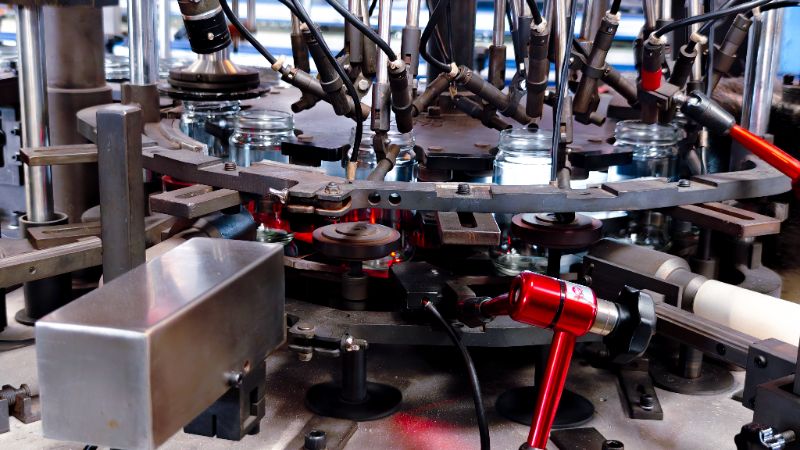
In-line inspection of glass containers during production — the point at which suspect units leave the flow before seal integrity control and the pre-shipment test.
Problem Definition: Why “Leak-Proof” and “Heat Resistant” Cannot Be Audited
A purchase specification that says a glass jar must be “leak-proof” and “heat resistant” transfers no risk to the supplier. Neither phrase identifies a test method, a coverage level, an acceptance criterion or a document. When a container leaks at the filling line six weeks later, the buyer has no clause to point to and the supplier has no record to defend against.Seal and thermal failures arrive through three separate doors, and each needs its own control:
· Seal failure. Leakage after filling, during storage or transport, or in consumer use. The documented triggers are cap torque set too low or too high, an aged or misaligned sealing ring, drops, pressure or temperature change, and long-term inverted storage.
· Thermal shock failure. Cracks or shattering when the jar meets a sudden temperature change — hot-water filling, moving straight from the refrigerator to heat, or dishwashing and microwave use. The documented trigger is a temperature differential that exceeds what the material tolerates.
· Transit breakage. Cracks, chips or breakage caused by insufficient cushioning, stacking pressure, drops during handling or rough parcel sorting.
There is a fourth, quieter risk that belongs in the same specification because it is released from the same surfaces: lead, cadmium and other heavy metals from glaze, ink, coating or metal parts in contact with food, triggered by acidic, hot or oily contents, prolonged storage or surface abrasion.
The practical consequence for a technical buyer is that the specification must be written at the level of the test, not the level of the promise. A clause reading “100% airtightness test on every unit, report per batch” is auditable. A clause reading “leak-proof” is not.
Industry Background: Test Records Are Now Part of the Compliance File
Glass jars and other glass containers used for the conveyance or packing of goods are declared under HS heading 7010, with standard glass containers for food and packing falling under HS Code 7010.90. The classification matters to a technical buyer for one reason: documentation is what customs, retailers and quality auditors ask for, and classification codes do not travel without a batch record behind them.
In the European Union, Regulation (EC) No 1935/2004 requires that food-contact materials such as glass jars and their closures do not transfer constituents to food in quantities that could endanger human health, bring about an unacceptable change in composition, or deteriorate organoleptic characteristics. Separately, Commission Regulation (EC) No 2023/2006 obliges operators manufacturing food-contact materials — including glass containers — to run a documented good manufacturing practice and quality assurance system.
Why this changes the specification conversation. A documented GMP and quality assurance system means test records are a deliverable, not a favour. It also explains why the EU framework is not a shortcut: the EU has not harmonised a specific measure for glass as a food-contact material, so compliance for glass jars relies on the framework regulation, GMP obligations and national provisions rather than on an EU-wide compositional limit list. Where the regulator supplies a framework rather than a number, the buyer’s own written specification and the supplier’s test reports carry correspondingly more weight.
Against that background, a supplier’s test regime is the practical evidence layer. IDEA PACKAGE holds ISO 9001 certification for its factory and states FDA and CE compliance for its products, which is the documentary context in which the batch-level test report sits.
Detailed Solution: The Four Controls Behind a Glass Jar Shipment
The test regime that supports a glass jar specification is not a single inspection. It is four controls operating at different points, each answering a different question, and each producing a different piece of evidence.
1. Seal Integrity Control: the 100% Airtightness Test
Seal integrity control is the primary defence, and its coverage level is the part buyers underestimate. The airtightness test is applied to every single unit, not drawn from a sample. That distinction is the difference between a batch that is statistically described and a batch that has been individually screened.
For a technical specification, the clause should read as a coverage statement: 100% airtightness testing on all units under seal integrity control, before dispatch, with the result captured in the batch test report. This is the clause that converts “leak-proof” into something a quality engineer can witness.
2. Cap Torque Control: the Variable That Decides Whether the Seal Holds
Airtightness testing alone does not control the mechanism that most often causes leakage. Cap torque does. The documented failure trigger is torque set too low, which allows leakage, or too high, which distorts the sealing ring; aged or misaligned sealing rings compound the problem.
IDEA PACKAGE therefore runs cap torque control alongside airtightness, with upper and lower torque limits defined and periodic equipment calibration. For a buyer specifying a glass jar with lid — whether the closure is a lug finish on a Mason jar, a twist-off on a jam jar, or a lined metal lid on a candle glass jar — the torque window belongs in the specification next to the airtightness requirement, because the two are functionally linked.
3. Thermal Shock Testing: Defining the Temperature Differential
Thermal stability is validated through a Thermal Shock Test, and the test’s output is a definition: the tolerable temperature differential for the container. That is the number a buyer needs, because “heat resistant” without a stated differential cannot be applied to a filling temperature, a pasteurisation step or a candle burn profile.
The test exists because the failure mode is specific. When the temperature differential exceeds material tolerance, the jar cracks or shatters — typically at the worst possible moment, which is during hot filling, on removal from refrigeration, or in a dishwasher or microwave cycle. The documented mitigation is thermal stability design and validation through the Thermal Shock Test, paired with handling instructions that state the temperature limits and warn against sudden hot-to-cold transitions.
Every single jar undergoes airtightness testing and thermal shock testing according to the manufacturer’s stated regime. For a specification, the practical instruction is to require the thermal shock result to be reported as a defined differential rather than as a pass/fail adjective, and to carry the same figure into the filling and handling instructions given to the packing line and, where relevant, to the end consumer.

Kiln stage in glass production. Thermal behaviour in the finished jar depends on the material and forming process upstream of the Thermal Shock Test.
4. Pre-Shipment Drop Testing: Validating the Packed Configuration
The drop test answers a different question from the first three: not whether the jar is sound, but whether the packed configuration survives handling. Breakage in transit is controlled through anti-shock, drop-resistant packaging — dividers separating each unit, foam lining cushioning the load, individual compartments so items cannot collide — and drop testing is completed before shipment to verify that the packaging holds up under handling and parcel sorting.
Two specification consequences follow. First, the drop test must be written against the packaging configuration, not the jar in isolation, because changing the divider, the foam or the carton count invalidates the previous result. Second, the drop test is a pre-shipment activity, which means it belongs on the shipment timeline and not in a general quality statement.
5. Heavy Metal Testing: the Compliance Layer that Shares the Same Record
Lead and cadmium control runs in parallel with the mechanical tests. Raw materials and finished products are tested by FDA and SGS for lead, cadmium and other heavy metals, and the jars have passed FDA and SGS standards regarding lead and cadmium content. Regular randomized follow-up testing is conducted on finished jars, which is what turns a one-off certificate into an ongoing control.
For the specification, this layer should be requested as documentation: the FDA/SGS report for the raw materials and the finished product, the scope of the test, and the re-sampling arrangement.
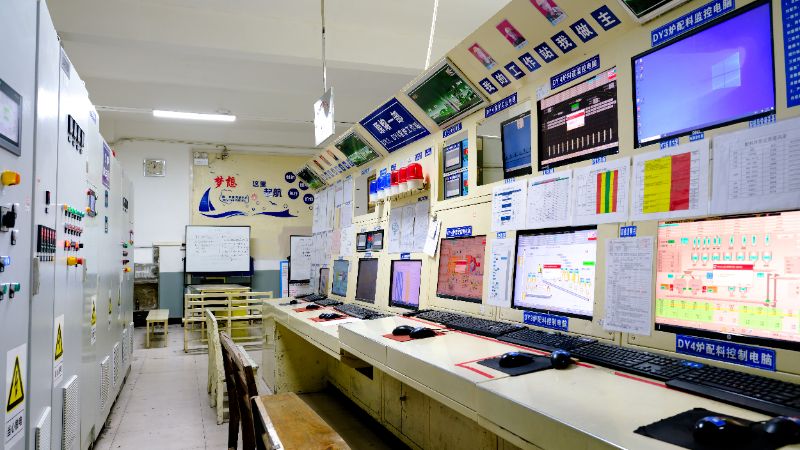
Raw material control room. Input control is where the heavy-metal compliance chain starts, before finished-product testing by FDA and SGS.
Step-by-Step Breakdown: Writing the Regime Into a Purchase Specification
The sequence below is the order in which the parameters should be fixed. Reversing any step moves the risk back onto the buyer.
1. State the application and the temperature envelope. Define what the jar will hold and how it will be handled — hot filling, chilled storage, dishwasher, candle burn. This is what the Thermal Shock Test result will later be compared against, and it decides whether the answer is a standard container or a modified design.
2. Fix the test items and the AQL level with the supplier before production starts. This is the single most important sequencing rule in the whole regime. Test items and AQL are agreed in advance, which means the acceptance criteria exist before the first jar is formed and cannot be redefined once a defect appears.
3. Lock the packaging configuration that the drop test will validate. Divider type, foam lining, compartment layout and carton arrangement should be frozen in the specification, because the pre-shipment drop test verifies that configuration and not a generic “export packing” claim.
4. Confirm the closure and torque window. Specify the glass jar lid type and require cap torque control with upper and lower limits and calibrated equipment. Airtightness on a jar tested without its production closure is not a meaningful result.
5. Run the batch and execute the pre-shipment test. Inspection for each production batch is carried out as a pre-shipment test before dispatch. The 100% airtightness test, the thermal shock validation and the drop test all sit inside this window.
6. Receive the test report as the inspection record. The corresponding test report is supplied as the inspection record for that batch. It is the document that closes the acceptance loop and the document an auditor will ask for.
7. Repeat the same items on every subsequent order. Long-term supply stability is not a relationship claim; it is the discipline of keeping identical test items, identical AQL and an identical report format on file so that batch thirty is comparable with batch one.
Use Cases: Where the Parameters Differ by Jar Family
The test regime is constant, but the emphasis shifts with the application. The same core controls produce quite different specification priorities across the jar families IDEA PACKAGE supplies.
Honey Jars and Jam Jars
Hot filling is the defining stress. A jam jar filled at elevated temperature and then cooled meets its thermal differential on the filling line, and a honey jar that later crystallises and is re-warmed meets it in the consumer’s kitchen. For both, the Thermal Shock Test result should be written against the actual filling temperature and the stated re-warming instructions, with the seal integrity requirement carrying the storage life of a high-sugar, high-acidity product.
Candle Glass Jars
A candle glass jar holds a sustained heat load rather than a short shock, and the container geometry — rim, wall thickness — is a safety variable rather than a purely aesthetic one. The specification should pair the thermal shock result with the cap torque and airtightness requirements only where a lid is used for retail presentation, and should treat heat resistance as a separate, explicitly stated parameter.
Mason Jars and Food Jars in Transit
For a glass mason jar or a general food jar, the dominant loss channel is the journey. The pre-shipment drop test on the packed configuration, the divider and foam specification, and the compartment layout carry more commercial weight than any single jar property, because breakage is controlled there.
Spice Jars and Glass Storage Jars
Small-format spice jars and larger glass storage jars sit at opposite ends of the size range and stress the seal differently: small closures concentrate torque sensitivity, while large jars concentrate stacking pressure. Both should be specified with torque limits and airtightness coverage, and both should carry the same heavy-metal documentation because the food-contact surface is identical in kind.
Coffee Jars and Closure Systems
A coffee jar specification typically combines aroma retention with mechanical sealing, which makes the airtightness test and the torque window the two clauses that matter most. Where the closure includes a coating or a lined lid, the coating compliance documentation should be requested at the same time as the mechanical test report, since both belong to the same food-contact file.
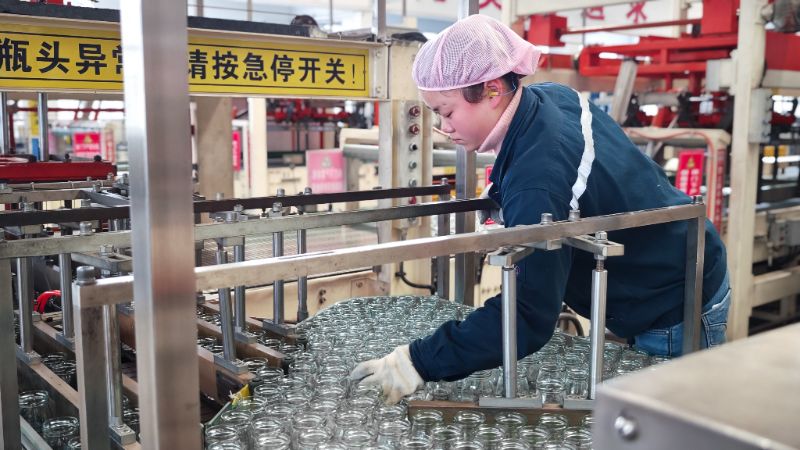
Manual quality inspection alongside automated controls. The pre-shipment test consolidates these checks into one batch record.
Comparison Table: The Test Regime at a Glance
The table below maps each control to what it verifies, its coverage level and the evidence it produces. Every entry reflects the documented regime described above; no numeric tolerance is asserted where the source does not state one.
| Control | What it verifies | Coverage | Control method | Evidence produced |
| 100% airtightness test | Seal integrity — leakage after filling, during storage and transport, or in consumer use | Every unit, under seal integrity control | Applied to all units before dispatch | Result captured in the batch pre-shipment test report |
| Cap torque control | Seal performance at the closure — torque too low or too high both cause failure | Runs with airtightness control | Upper and lower torque limits; periodic equipment calibration | Torque limits and calibration record held on file |
| Thermal Shock Test | Thermal stability — cracking or shattering under sudden temperature change | Every single jar, per the stated regime | Thermal stability design and validation | Tolerable temperature differential defined by the test |
| Pre-shipment drop test | Packed configuration resistance to handling and parcel sorting | The packed configuration, before shipment | Dividers, foam lining, individual compartments; drop testing completed before shipment | Drop test completed and reported with the batch |
| Heavy metal testing (FDA / SGS) | Lead, cadmium and other heavy metals released from glaze, ink, coating or metal food-contact parts | Raw materials and finished products | Food-grade sourcing plus regular randomized follow-up testing | FDA / SGS reports archived, with periodic re-sampling |
Specification Clauses to Agree Before Production Starts
The commercial and inspection clauses below are the ones that determine whether the test regime can actually be executed on your order. They are documented terms, not negotiating positions.
| Specification clause | What to write | Basis |
| Minimum order quantity | 5,000 pcs at standard mass-production pricing | Standard commercial terms |
| Incoterm | FOB, CIF or EXW — EXW where the buyer uses its own forwarder; FOB where the buyer nominates the vessel and pays freight; CIF where the supplier covers freight and insurance to the destination port | Standard commercial terms |
| Test items and AQL | Listed and agreed with the supplier before production starts | Inspection clause |
| Inspection record | Pre-shipment test executed before dispatch; test report supplied as the inspection record for each batch | Inspection clause |
| Payment | 30% T/T deposit before production; 70% T/T against a copy of the B/L | Standard commercial terms |
100% Airtightness testing applied to every unit, not to a sample
Per batch Pre-shipment test report issued as the inspection record
Agreed first Test items and AQL fixed before production starts
5,000 pcs Minimum order quantity at standard mass-production pricing
FAQ: Seal Integrity, Thermal Shock and Long-Term Documentation
What documentation proves that a glass jar batch passed seal integrity and thermal shock testing?
The inspection record is the pre-shipment test report. For each production batch, inspection is carried out as a pre-shipment test before dispatch, and the corresponding test report is supplied as the inspection record. It is issued against the test items and AQL level agreed with the buyer before production started, so the report can be read against a known acceptance criteria set rather than against a general quality claim. Heavy-metal documentation sits alongside it: raw materials and finished products are tested by FDA and SGS for lead and cadmium, with regular randomized follow-up testing.
Can a supplier test every unit for airtightness instead of only a sample?
Yes, and this is the coverage level to write into the specification. Under seal integrity control, every single unit passes the 100% airtightness test, and every single jar also undergoes thermal shock testing. The AQL level is a separate parameter: it is agreed with the buyer before production starts and sits alongside the listed test items, defining the acceptance level for the batch inspection. AQL does not replace the 100% test — it is the second, complementary layer. Cap torque control with defined upper and lower limits and periodic equipment calibration supports both.
Do seal integrity, thermal shock and drop testing change the price or the minimum order?
The documented commercial framework is fixed independently of the test regime: the minimum order quantity for glass jar orders at standard mass-production pricing is 5,000 pcs, delivery terms are FOB, CIF or EXW, and payment is 30% T/T deposit before production with 70% T/T against a copy of the B/L. What the test regime changes is the point at which the inspection scope is settled. Because test items and AQL are agreed before production starts, the inspection scope is defined before the batch is made rather than after it is packed, which is what prevents a dispute over acceptance criteria from becoming a commercial dispute over price.
Can test items and AQL be fixed before tooling and mass production begin?
That is the correct sequence and the documented one: test items and AQL are agreed with the buyer before production starts. Practically, this means the specification conversation — the jar family, the filling temperature the Thermal Shock Test result must cover, the closure and torque window, the packaging configuration the drop test will validate, and the heavy-metal documentation scope — is settled at the sample and quotation stage. A supplier who can only describe acceptance criteria after the batch exists has not agreed them at all.
How do pre-shipment tests affect lead time, and how do I keep documentation stable across repeat orders?
The pre-shipment test is sequenced into the shipment schedule rather than added after it: inspection is carried out before dispatch, and the test report travels with the batch as its inspection record. Long-term documentation stability comes from discipline rather than from any single certificate — keeping the same test items, the same AQL and the same report format on file for every repeat order, so that each batch report is directly comparable with the one before it. IDEA PACKAGE supports 15 R&D engineers and an annual production output of 180,000,000 CNY, and holds ISO 9001 certification with FDA and CE compliance stated for its products.
To move this into your own purchase specification, request the current test-item list and a sample batch report format before the next order is placed. Email tom.ideabottle@gmail.com or message +86 185-5501-9935 on WhatsApp, and the 2026 glass catalogue can be downloaded here: 2026 Glass Products Catalogue (PDF).
Conclusion: Specify the Test, Not the Adjective
A glass jar specification becomes enforceable at the moment it names a test, a coverage level, an acceptance criterion and a record. Four controls carry that load: the 100% airtightness test applied to every unit under seal integrity control, cap torque control with defined limits and calibrated equipment, the Thermal Shock Test that defines the tolerable temperature differential, and the pre-shipment drop test that validates the packed configuration. A fifth layer — FDA and SGS testing of raw materials and finished products for lead and cadmium, with regular randomized follow-up — completes the food-contact file.
The sequencing is what protects the buyer. Test items and AQL agreed before production starts, inspection executed as a pre-shipment test before dispatch, and a test report supplied per batch as the inspection record. On commercial terms, that regime sits inside a documented framework of 5,000 pcs minimum order quantity at standard mass-production pricing, FOB/CIF/EXW delivery, and 30% T/T deposit with 70% T/T against a copy of the B/L.
For technical buyers assessing long-term supply, the test report is also the most reliable signal available. A supplier that can produce a comparable batch record for every order — same test items, same AQL, same format — is demonstrating documentation continuity, and documentation continuity is what batch traceability is actually made of.
Next Step: Get the Test Parameters Before You Write the Spec
IDEA PACKAGE supplies glass jars — Mason jars, food jars, jam jars, honey jars, spice jars, coffee jars, candle glass jars and glass storage jars with lids — from a manufacturer holding ISO 9001 certification and stating FDA and CE compliance, exporting to over 150 countries and regions.
Send your filling temperature, closure type and pack configuration, and request the current test-item list, the AQL agreement format and a sample batch test report.
IDEA PACKAGE — ANHUI IDEA TECHNOLOGY IMP&EXP Co.,Ltd.
Email: tom.ideabottle@gmail.com | Tel / WhatsApp: +86 185-5501-9935
Website: www.ideabottles.com
Address: 32nd Floor, Huiyan Anhui Center, 180 Changjiang Middle Road, Luyang District, Hefei City, Anhui Province, China
Catalogue: 2026 Glass Products Catalogue (PDF)

Production base in Hefei, China — where the batch is formed, inspected and tested before dispatch.