PET Preform Sourcing: 28mm Specs and Food-Contact Compliance
The Real Cost of a Vague Preform RFQ
Most of the problems we deal with on the PET preform line do not start at the moulding machine. They start in the email where a buyer asks for a quote without specifying the parameters that actually matter. We have seen preforms arrive at a customer's filling line with caps that do not seat properly, bottles that blow out on the first run, and compliance teams asking for documents that should have been requested weeks earlier.
Three gaps show up so consistently that they are worth naming:
First, the neck-to-cap interface is left to chance. A 28mm neck is machined to tight tolerances — we are talking about fractions of a millimetre. When a buyer gets the preform from us and the cap from somewhere else, no one is responsible for that interface. If the torque test fails, each supplier points at the other. We always tell buyers the same thing: if you are not buying preforms and caps as a matched set, at least run a fitment test with both samples before either order goes into production.
Second, "food grade" is used as if it were a specification. It is not. It is a claim. The specification is the test report behind the claim — the regulation it references, the laboratory that issued it, the report number, and the date. Without those four items, the statement "food grade" will not hold up in a retailer audit or a regulatory review.
Third, preform weight is treated as a factory detail rather than a buyer decision. Weight controls wall thickness after blowing. A preform that is slightly underweight produces a bottle with thin spots that may fail drop tests or stacking loads. The safeguard is automatic checkweighing on the injection line — but the buyer has to specify the target weight and ask how the factory controls it. Leaving it blank in the RFQ means accepting whatever comes off the machine.
From Afterthought to First Question: How Compliance Reshaped Supplier Selection
Five years ago, most buyers collected food-contact paperwork after the order was placed — it was a box to tick, not a decision criterion. That no longer works. The global PET preform market is heading toward USD 78.74 billion by 2034, and with that scale has come tighter regulatory attention. Buyers now ask for documentation at the enquiry stage, and suppliers who cannot produce it quickly get filtered out before price is even discussed.
The reason compliance sits at the preform level is straightforward: the preform is the contact surface. It is the plastic that touches the water, juice, or oil inside the bottle. So when a brand owner or retailer audits the packaging chain, the trail starts at the preform converter — not at the bottle moulder or the label printer.
Two regulatory currents are worth tracking:
- Virgin PET still drives the market at roughly 72% of material demand. Today's compliance questions are mostly about virgin resin migration limits — overall migration, heavy metals, antimony, ethylene glycol.
- Recycled content is becoming mandatory, not optional. The EU Single Use Plastics Directive requires PET beverage bottles to contain at least 30% recycled material by 2030. That obligation runs upstream to the preform supplier, because rPET processing capability is a manufacturing-side decision — the brand owner cannot add recycled content at the filling line.
The practical move for a buyer placing a 28mm order today: use compliance documentation to narrow the supplier shortlist, and ask about rPET capability as a separate question to see which suppliers can still serve an EU-facing brand after 2030.
Neck, Resin, Colour, Weight: Four Parameters You Cannot Leave Blank
A PET preform is not a single product — it is a combination of parameters, each of which needs to be pinned down before sampling. Here is what each one controls and why it matters to the buyer:
- Neck finish (20mm / 24mm / 28mm / 30mm / 32mm / custom). The 28mm is the most commonly traded size in our range and the default for water, beverage, and oil bottles. But a catalogue listing is not a production spec — confirm the exact neck dimension on the technical drawing, not in the product description. If your brand uses a proprietary closure, custom millimetre dimensions are available, but the drawing must be agreed before tooling starts.
- Material (food-grade virgin PET). The resin itself is food-grade PET — but the real question is whether the supplier can produce a test report tied to the specific preform model. The report should name the regulation, the issuing lab, the report number, and the issue date. "Food grade" without a report is a claim; "food grade" with report number 180327075a 001 from TüV Rheinland is a verifiable fact.
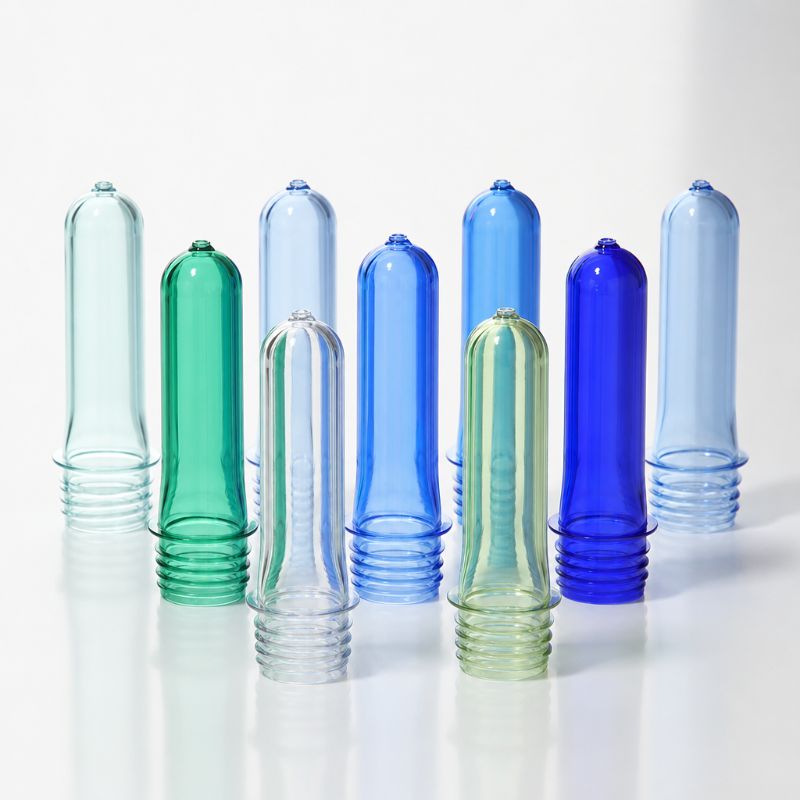
- Colour (natural clear / green / blue / amber / custom). Clear is the default for water and most beverages. Tinted options exist for brand differentiation. The catch: resin colour does not match screen colour. Approve against a physical sample retained as a standard, because correcting a colour mismatch after 100,000 preforms are moulded is costly and slow.
- Weight (specified in grams). This is the parameter buyers most frequently omit — and it is the one that controls wall thickness. Too light means thin walls and potential failures; too heavy means wasted resin and altered bottle rigidity. State the target weight, and confirm that the factory runs automatic checkweighing to catch any unit outside tolerance.
Two Reports, Two Frameworks: What They Actually Prove
The food-contact compliance position for our PET preform range — including model Water Bottle Preform-401 — is documented by two test reports issued in 2025. They are not redundant; they cover different regulatory frameworks and different test panels.
The EU report (180327075a 001). Issued by TüV Rheinland/CCIC (Ningbo) on 23 April 2025. This one maps to Regulation (EC) No 1935/2004 and Commission Regulation (EU) No 10/2011. The test panel is broad: overall migration, specific migration of 18 metals, primary aromatic amines, colourfastness, terephthalic and isophthalic acid, ethylene glycol, antimony, and sensorial assessment. If you are supplying a European brand owner or selling into an EU market, this is the report that lines up with their audit questionnaire.
The GB report (TZA25001027). Issued by Taizhou Customs Comprehensive Technology Service Center on 25 June 2025. This one tests against GB 4806.7-2023 and related Chinese GB standards. The scope covers overall migration, KMnO? consumption, heavy metals (as Pb), decolorization, and antimony. For buyers operating in China or supplying domestic filling plants, this is the baseline framework.
Why carry both? Because they answer different regulatory questions. A buyer who needs to satisfy a European retailer and a Chinese filling plant can point to both in a single supplier file, rather than chasing a second report mid-project.
Where the evidence stops: Both reports are migration and residue tests for food-contact plastic. They are not recycled-content certificates. Our preforms are moulded from virgin food-grade PET. If your brand needs to meet the EU 30% rPET target, that is a separate manufacturing question — confirm rPET availability for your neck size and weight before assuming it is covered.
Walking a Supplier Through Qualification: A Practical Sequence
The order in which you verify a supplier matters. Some decisions become expensive to reverse once production has started, so the qualification steps should follow that risk sequence.
Start with the cap, not the preform. Before requesting a quote, decide on the closure. A 28mm neck is only as reliable as the cap that seals it. If you are sourcing the cap elsewhere, get sample preforms and run a fitment test with your actual closure before either order moves forward.
Ask for numbers, not assurances. The first compliance question to any supplier should be: report number, issuing laboratory, issue date, and referenced regulation. A supplier who can answer those four items immediately has the documentation in hand. One who cannot probably does not.
Verify neck tolerance control on the line. Dimensional spot checks and cap fitment tests should be part of routine production — not just something done at sample stage. Ask how the supplier controls neck tolerance in daily production, then repeat the fitment test yourself with your own closure on the samples you receive.
Verify weight control on the line. Automatic checkweighing at the injection machine is what catches weight drift before it reaches your blowing line. If the supplier relies on manual sampling, you are taking on a higher reject risk that you will only discover after blowing.
Approve colour and branding physically. Available colours include natural clear, green, blue, amber, and custom matches. Logo or printed branding can be applied. Approval must happen against a physical retained standard — never against a screen image.
Lock down the commercial terms in writing. MOQ is 10,000 pieces with price breaks at higher volumes. Monthly capacity is 500,000 pieces. Lead time runs 15 days for orders up to 200,000 pieces; above that, delivery is negotiated. Production is OEM/ODM.
Agree inspection before production, not after. Pre-shipment inspection with a test report is standard practice. But it only protects you if the test items and AQL are fixed before the run begins. Trade terms are FOB, CIF, or EXW. Payment is 30% T/T deposit with 70% against B/L copy.
From Water to Oil: Where These Preforms Actually Ship
Our PET preform range serves drinking water, beverage, edible oil, condiment, and daily chemical applications. The four product types that account for most orders are water bottle preforms, oil preforms, cosmetic preforms, and wide-mouth preforms.
Repeat orders tell the story better than a spec sheet. A water treatment plant runs an annual contract at USD 500,000 — their driver is consistent food-grade documentation across every shipment. A juice factory at USD 400,000 per year prioritises filling-line stability and qualified product rates. An oil processing plant at USD 300,000 annually needs wall thickness that holds up under edible oil contact. A health supplement factory at USD 500,000 per year requires stable filling performance with food-grade compliance as the baseline.
The common thread is not a headline feature. It is repeatability — the same neck dimension, the same weight, the same compliance paperwork, shipment after shipment.
The Multi-Material Advantage: One Supplier, Three Packaging Materials
IDEA PACKAGE is the brand of Anhui IDEA Technology Co., Ltd., headquartered in Hefei, China, with over 20 years in packaging manufacturing. The group operates three production bases covering glass, plastic, and metal packaging across more than 65,000 square metres, with over 200 staff and 15 designers. ISO 9001, FDA, and CE certifications cover the facilities, and products ship to more than 150 countries serving over 2,500 clients.
For a PET preform buyer, the advantage of sourcing from a multi-material group is consolidation. A beverage portfolio that includes PET water bottles, glass juice bottles, and aluminum energy drink cans can be sourced from one supplier — along with the closures — under one quality system and one shipment schedule. The trade-off is honest: a single-material preform specialist may carry deeper preform-specific tooling knowledge, while a group structure offers breadth and fewer purchase orders to coordinate. The right fit depends on whether your portfolio is single-format or mixed.

Boundaries That Buyers Should Confirm in Writing
A credible supplier states what it cannot do as clearly as what it can. Four points sit outside the documented specification and should be confirmed before committing to an order:
- Recycled content. Current production uses virgin food-grade PET. The EU 30% rPET mandate for 2030 is approaching. If your brand sells into Europe, raise rPET availability at enquiry stage — do not assume it is covered by the migration reports.
- Hot-fill and acidic products. The published application guidance advises against prolonged hot filling and extended contact with highly acidic or high-alcohol formulations. If your product falls into either category, confirm suitability in writing.
- Pricing. Unit price depends on neck size, weight, colour, decoration, quantity, and Incoterms. There is no standard price without a defined specification — a quotation must be tied to your actual parameters.
- Regulations beyond EU and GB. The two reports cover the European and Chinese frameworks. If you are targeting a market with additional national requirements (such as FDA), ask at enquiry stage.
Where PET Preform Procurement Is Heading
The next procurement cycle will look different. Specification sheets are becoming more granular — separating neck finish, weight, material compliance, and filling conditions rather than bundling them into a single SKU. Compliance questions are arriving earlier in the sourcing timeline. And recycled content is shifting from a sustainability narrative to a regulatory line item that procurement teams must address at the preform stage.
For buyers, the move is toward evidence-based supplier selection. A preform RFQ that asks for report numbers, neck tolerance methods, weight control processes, and rPET capability will produce a very different shortlist than one that simply asks for a price on "28mm preforms." At IDEA PACKAGE, we have structured our PET preform range around exactly those questions — documented test reports, tolerance-controlled necks, auditable weight controls, and commercial terms stated without ambiguity.
Next step: Send the neck size, target weight, colour, quantity, and destination port. We will return a specification-matched quotation, and samples are available for cap fitment and blow trials on your own production line.