Four Glass Jar Risks Ranked: Which Controls Deserve Priority Before Shipment
Pre-shipment risk control
The four glass jar risks that deserve priority before shipment are, in practical order: breakage first, leakage or seal failure second, thermal shock third, and heavy metal release fourth. That ranking is a procurement prioritization based on how each failure reaches the buyer and how much of a shipment it can affect. It is not a measured claim-rate study. In this order, the two controls that sit near the top are a 100% airtightness test on every unit and pre-shipment drop testing. Lead and cadmium control works differently: it is handled through FDA and SGS standards plus randomized follow-up testing.
IDEA PACKAGE is the brand of Anhui IDEA Technology Imp & Exp Co., Ltd., a Hefei, China–based packaging solutions provider that supplies glass jars and aluminum cans to global markets. The controls described here are drawn from the supplier’s stated glass jar risk-control approach, product specifications and application requirements. Buyers can use the ranking to order an inspection checklist and to decide which evidence to request first.
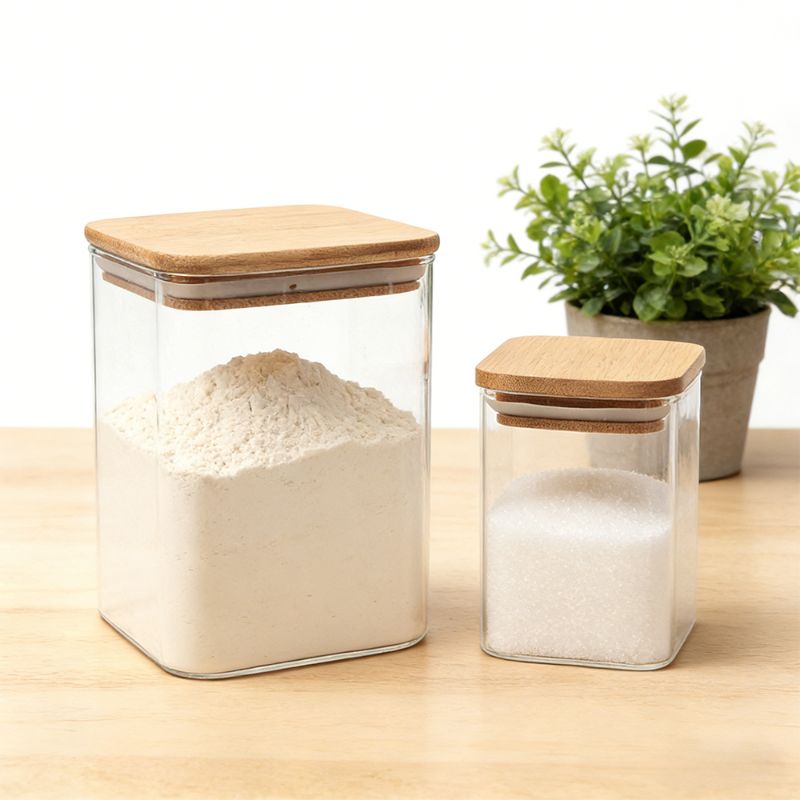
Cover image: a glass storage jar with lid from the IDEA PACKAGE glass jar range. Risk control starts with the jar, the closure and the shipment format, not with a single test certificate.
Problem Definition: Why Four Glass Jar Risks Need a Priority Order
A glass jar can fail in different ways, and each failure has a different control point. Breakage is a mechanical problem. Leakage or seal failure is a closure-integrity problem. Thermal shock is a temperature-change problem. Heavy metal release is a food-contact compliance problem. Treating all four as equal creates a checklist that is long, expensive and hard to close before shipment.
The buyer’s problem is not knowing that these risks exist. Most glass jar buyers already ask about breakage and leakage. The harder problem is deciding which control deserves to be verified first, which evidence should be requested before a purchase order, and which test can be sampled rather than applied to every unit. That is why the ranking matters.
For food packaging projects, the application requirement adds food-grade materials, FDA and LFGB compliance, and a leak-proof seal. These requirements push seal integrity and food-contact compliance into the specification stage. For candle glass jars and other heat-exposed formats, thermal shock becomes more visible to the end user. For large glass jar or glass jar set programs, packaging and palletization can change the breakage exposure. The same jar family can therefore carry a different priority order by application.
A useful rule for buyers: prioritize the failure that can affect a whole shipment before the failure that is controlled by a certificate. Breakage and seal failure can downgrade an entire lot. Heavy metal release is a compliance gate, but it is usually managed through material and finished-product testing rather than through visual inspection on the line.
Industry Background: Glass Jar Risk Control Is Application-Specific
Glass jars are used across food, condiment, honey, jam, coffee, spice, candle, beauty and home storage applications. The product range described for IDEA PACKAGE includes glass storage jar, glass mason jar, freezing glass jar, glass honey jar, glass jam jar, glass coffee jar, glass pudding jar, glass spice jar, glass pickle jar, glass candle jar and glass cream jar. Capacity options include 200, 250, 500, 750, 1000 and 1500 ml, with hexagonal, round, square and cylindrical shapes. Glass material can be borosilicate glass or soda-lime glass, with clear or customizable color. Closure options include food-grade silicone or rubber seals and wood, aluminum, plastic or tinplate screw caps.
That variety explains why risk control cannot be copied from one jar program to another. A mini glass jar used for a sample or spice pack has a different handling profile from a large glass jar used for pickles or storage. A glass jar with lid for honey or jam may be filled on a manual or semi-automatic line, while a coffee jar or condiment jar may run on a filling machine, capping machine and labeling machine. The application scenario described for these jars includes indoor storage, normal room temperature, a dry environment, product storage, sealing preservation and display packaging. Those conditions are moderate, but transport and filling still create mechanical and seal stress.
Food-contact rules add a second layer. In the EU, Regulation (EC) No 1935/2004 requires food-contact materials not to transfer constituents to food in quantities that could endanger human health, cause an unacceptable change in composition or deteriorate organoleptic characteristics. Commission Regulation (EC) No 2023/2006 requires documented good manufacturing practice and quality assurance for food-contact material manufacturing. In the United States, 21 CFR 175.300 covers resinous and polymeric coatings used as the food-contact surface of articles, including organic coatings applied to glass containers and closures. China applies GB 4806.5-2016 to glass products in contact with food. These rules make heavy metal release a documentation and testing issue, not only a visual quality issue.
The supplier’s stated position is that raw materials and finished products are tested by FDA and SGS under food-grade compliance for lead and cadmium, with regular randomized follow-up testing. The same risk-control statement says every jar undergoes 100% airtightness testing and thermal shock testing, and that packaging uses dividers and foam cushioning with drop tests before shipment. Those controls map directly to the four-risk ranking.
Detailed Solution: Ranking the Four Glass Jar Risks
The ranking below uses three questions. First, how likely is the failure to appear during normal packing, filling, transport or storage? Second, how much of a shipment can one failure event affect? Third, what evidence can the buyer verify before shipment? The order is breakage, leakage or seal failure, thermal shock, and heavy metal release. Heavy metal release ranks fourth in day-to-day likelihood but remains a non-negotiable compliance gate.
Rank 1: Breakage
Breakage ranks first because glass jars are exposed to handling, carton stacking, pallet movement and transport vibration before they reach the filling line or the end customer. A single impact can damage multiple units in the same carton. The failure cost is immediate: lost product, contaminated packaging, line interruption, manual sorting, returns and possible injury risk from broken glass. For a large glass jar program, the cost per event is higher because fewer units fit per carton and replacement freight is less efficient.
The control stated for this risk is packaging equipped with dividers and foam cushioning, plus drop tests before shipment. That combination addresses two different failure points. Dividers reduce jar-to-jar contact. Foam cushioning absorbs impact energy. Drop testing checks the packed configuration, not only the bare jar. The buyer should verify the drop-test report and the packaging specification before production, not after the goods are ready.
Breakage control should also match the jar format. A round jar, a square jar, a hexagonal jar and a cylindrical jar do not pack the same way. A glass jar set with multiple sizes needs a carton layout that prevents movement between compartments. A mini glass jar may need different cushioning from a large glass jar. The inspection question is therefore specific: show the packed configuration that was drop tested, and confirm that the production packing will use the same dividers, foam and carton arrangement.
Rank 2: Leakage or Seal Failure
Leakage or seal failure ranks second because it can occur even when the glass body is intact. The closure interface is a system: the glass finish, the glass jar lid, the food-grade silicone or rubber seal, and the capping method all affect integrity. A jar can pass a visual check and still fail under transport vibration or pressure change. The failure cost is high because leaked contents can stain labels, contaminate adjacent units and turn a food-grade shipment into a rejected lot.
The control stated for this risk is a 100% airtightness test on every unit before shipment under seal integrity control. That is a stronger position than relying only on a sample. A 100% test is unit-level; it is designed to catch individual seal defects rather than estimate a lot average. The application requirement also specifies a leak-proof seal, and the closure range includes tinplate twist-off lids described as rust-resistant, easy to open and able to provide an airtight, freshness-preserving seal that extends shelf life and prevents leakage during transport.
Buyers should still ask how the test is performed and what acceptance criteria are used. The commercial FAQ states that goods are inspected by pre-shipment test before they leave, with a test report provided, and that test items and AQL should be agreed before production starts. That is the correct sequence. A test report produced after the shipment is packed is useful evidence, but it is weaker than a pre-agreed test protocol. For honey jar, jam jar, coffee jar or condiment jar programs, the closure and filling method should be fixed before the airtightness protocol is approved.
Rank 3: Thermal Shock
Thermal shock ranks third because it requires a temperature differential rather than ordinary handling. The consequence can still be severe: a jar may crack, weaken or fail after filling, washing or temperature change. The cost is a delayed release, rework or a customer complaint that appears after the product has left the plant. Candle glass jars and food jars that move between warm filling and cooler storage are practical examples where the buyer should ask for thermal-shock evidence.
The control stated for this risk is thermal shock testing on every jar. That is a strong control because it checks the jar body rather than only the packed carton. The buyer should request the test method and the condition range used, and should confirm that the test reflects the actual filling and storage conditions. For a freezing glass jar or a candle glass jar, the relevant temperature profile may differ from a shelf-stable honey jar or spice jar. Do not assume that one thermal-shock report covers every jar size or every glass material.
Thermal shock also interacts with breakage. A jar that survives a drop test may still fail after a temperature change, and a jar that passes thermal shock may still break if the carton is dropped. That is why the two controls should be requested together, not traded against each other.
Rank 4: Heavy Metal Release
Heavy metal release ranks fourth in day-to-day likelihood but remains a compliance gate. The risk is the release of lead or cadmium above applicable limits from raw materials or finished products. The failure cost is not a single broken jar; it is a regulatory rejection, recall, market-access block or customer specification failure. That is why this risk is handled through material and finished-product testing rather than through visual inspection on the packing line.
The stated control is FDA and SGS testing of raw materials and finished products under food-grade compliance, plus regular randomized follow-up testing. The supplier’s facilities are also described as ISO 9001, FDA and CE-certified, which supports the quality-system side of the claim. For buyers, the practical evidence is a current test report that identifies the product, the material, the test standard and the result. A generic certificate without a product identity is not enough for a food jar program.
Market-specific rules should be checked against the destination. The EU framework and GMP rules, US coating rules under 21 CFR 175.300, and China’s GB 4806.5-2016 all point to a documented food-contact control system. The buyer does not need to rewrite the regulation. The buyer needs to confirm that the supplier can provide the relevant test evidence for the jar and closure being purchased.
Why 100% Airtightness and Pre-Shipment Drop Testing Sit Near the Top
These two controls sit near the top because they answer the two risks that can change the status of a shipment before the buyer opens the first carton. A 100% airtightness test on every unit addresses leakage or seal failure at the unit level. Pre-shipment drop testing addresses breakage at the packed-configuration level. One is a seal-integrity control; the other is a transport-protection control. Both produce evidence before the goods leave, which is the point of a pre-shipment control.
Heavy metal release is also critical, but it is controlled differently. It relies on material selection, FDA and SGS testing, and randomized follow-up testing. It is not practical to screen every jar for lead or cadmium on the packing line in the same way that every unit can be checked for airtightness. That is why compliance testing and 100% seal testing belong in different parts of the buyer’s checklist. The ranking does not reduce the importance of compliance. It assigns the right control to the right failure mode.
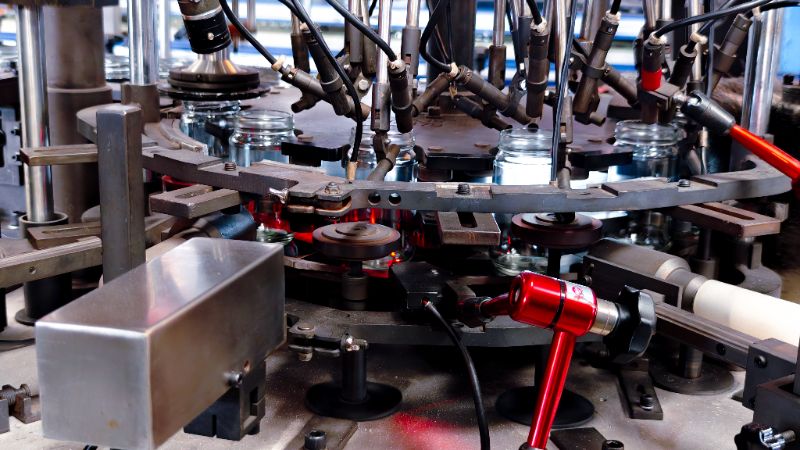
Inspection equipment supports the principle behind 100% airtightness testing: verify the unit, not only the lot average. Image: machine for inspecting glass bottles at IDEA PACKAGE.
Step-by-Step Breakdown: What Buyers Should Verify First
The checklist below follows the risk ranking. It is ordered by what to verify first, not by what is easiest to request. The sequence also prevents a common mistake: collecting certificates before confirming that the packed product can survive transport.
Step 1 — Confirm the application and closure. Define whether the jar is for food, condiment, honey, jam, coffee, spice, candle or home storage use. Confirm the glass jar lid type, the food-grade silicone or rubber seal, and the filling and capping method. The application scenario for these jars includes food-grade materials, FDA and LFGB compliance, and a leak-proof seal.
Step 2 — Request the 100% airtightness test protocol. Ask how every unit is tested, what constitutes a pass or fail, and how the test report is issued. The supplier states that every single jar undergoes 100% airtightness testing before shipment under seal integrity control.
Step 3 — Request the pre-shipment drop test and packing specification. Confirm dividers, foam cushioning and carton layout. The supplier states that packaging uses dividers and foam cushioning and that drop tests are conducted before shipment. Verify that production packing will match the tested configuration.
Step 4 — Request thermal shock test evidence. Confirm the test method and the condition range. The supplier states that every jar undergoes thermal shock testing. Match the evidence to the jar size, glass material and application.
Step 5 — Request FDA and SGS lead and cadmium test reports. Confirm that the report identifies the jar and closure being purchased. The stated control is testing of raw materials and finished products by FDA and SGS under food-grade compliance, with regular randomized follow-up testing.
Step 6 — Verify product specifications against the purchase order. Check capacity, shape, glass material, glass color, seal material, printing method and logo customization. The stated range covers 200, 250, 500, 750, 1000 and 1500 ml capacities; hexagonal, round, square and cylindrical shapes; borosilicate or soda-lime glass; clear or customizable color; silicone or rubber food-grade seals; and screen printing, hot stamping or decals.
Step 7 — Agree test items and AQL before production. The commercial terms state that goods are inspected by pre-shipment test before they leave, with a test report provided, and that test items and AQL should be agreed with the supplier before production starts.
Step 8 — Confirm commercial terms and documentation. The stated terms are MOQ 5000 pcs, FOB, CIF or EXW, 30% T/T deposit before production and 70% T/T against a copy of the B/L. Lead time is 7 days for 5,000–10,000 pcs and 20 days for 10,000–50,000 pcs; above 50,000 pcs is negotiable.
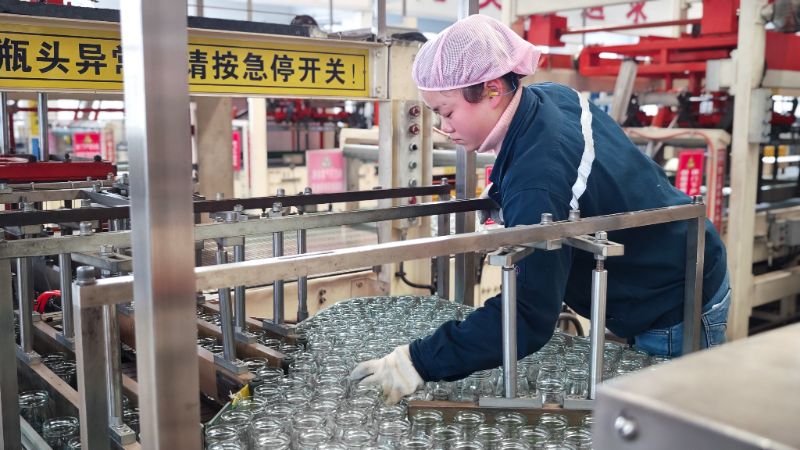
Manual quality inspection is a final check, not a substitute for a 100% airtightness test or a pre-shipment drop test. Image: manual quality inspection at IDEA PACKAGE.
Use Cases: How the Ranking Changes by Application
For food packaging projects, the application requirement is explicit: food-grade materials, FDA and LFGB compliance, and a leak-proof seal, used in the food and condiment industries for global markets. In that setting, leakage or seal failure can move ahead of breakage if the product is liquid or semi-liquid. A honey jar or jam jar with a poor seal is a direct product-loss event. That is why the 100% airtightness test belongs at the top of the food-jar checklist even when breakage remains the more visible transport risk.
In an Australian coffee processing project, glass jar packaging was used for canned coffee production, and the stated result was stable production operation with food-grade packaging requirements met. In a global coffee processing project, the same pattern appears: glass jar packaging for canned coffee production, food-grade packaging requirements met, and stable production operation. These cases support the food-grade and sealing emphasis, but they do not replace the need to verify the jar and closure specification for the actual fill.
For canned pickles production, the packaging material is described as corrosion resistant, with food-grade quality, sealing performance and corrosion resistance highlighted. That use case adds a product-contact consideration to the seal and glass-body checks. A pickle jar program should confirm the closure, the seal material and the food-contact reports together. A glass jar set or a large glass jar program may also need a carton layout review because the packed weight and handling profile differ from a small spice jar or mini glass jar.
Candle glass jars follow a different emphasis. Thermal shock and heat exposure are practical concerns, so the thermal-shock evidence should be requested early. At the same time, the jar still needs a sound packing configuration and a closure that suits the candle format. The ranking does not change the four risks; it changes which control the buyer verifies first.
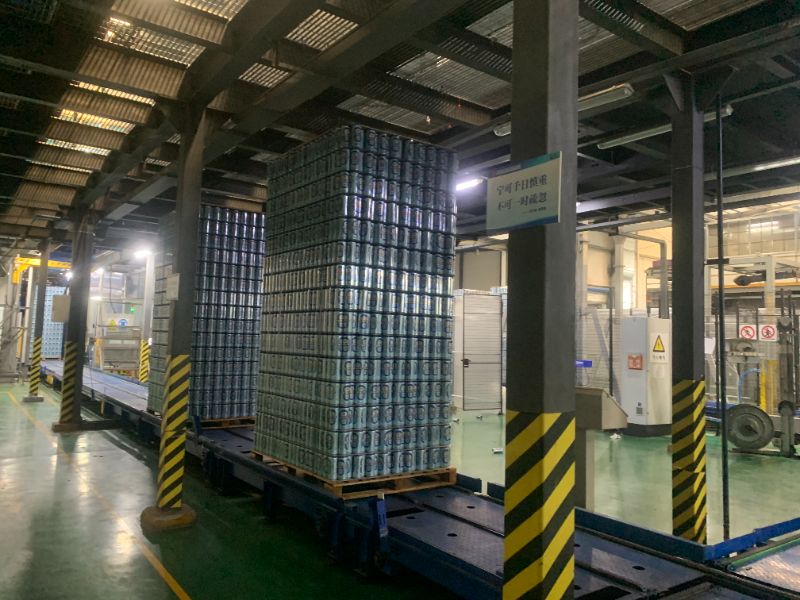
Palletizing and carton layout are part of breakage control. The drop test should reflect the packed configuration that will actually ship. Image: palletizing at IDEA PACKAGE.
Comparison Table: Risk Priority, Control and Verification
| Priority | Glass jar risk | Why it ranks here | Primary control | What the buyer should verify |
| 1 | Breakage | Can occur in handling, carton stacking and transport; one event can affect multiple units. | Dividers and foam cushioning plus pre-shipment drop testing. | Drop-test report and production packing specification. |
| 2 | Leakage or seal failure | Can occur at the closure interface even when the glass body is intact; affects food-grade acceptance. | 100% airtightness test on every unit under seal integrity control. | Test protocol, pass-fail criteria and report; leak-proof seal requirement. |
| 3 | Thermal shock | Requires a temperature differential; failure may appear after filling, washing or storage. | Thermal shock testing on every jar. | Test method, condition range and match to the application. |
| 4 | Heavy metal release | Lower day-to-day likelihood but a compliance gate with high market-access cost. | FDA and SGS testing of raw materials and finished products, plus regular randomized follow-up testing. | Current lead and cadmium test report tied to the jar and closure. |
FAQ
Are glass jars leak-proof?
IDEA PACKAGE states that every unit passes a 100% airtightness test before shipment under seal integrity control, and the application requirement includes a leak-proof seal. Buyers should still confirm the test method, acceptance criteria and report format before production starts.
What tests should be requested before shipment?
Request the 100% airtightness test on every unit, pre-shipment drop testing, thermal shock testing, and FDA and SGS lead and cadmium test reports. Also agree the pre-shipment inspection items and AQL before production, because the supplier states that goods are inspected by pre-shipment test before they leave and that a test report is provided.
How are lead and cadmium controlled in glass jars?
The stated control is testing of raw materials and finished products by FDA and SGS under food-grade compliance, plus regular randomized follow-up testing. The supplier’s facilities are described as ISO 9001, FDA and CE-certified. For a specific order, the buyer should request a report that identifies the jar and closure being purchased.
How should buyers evaluate China glass jar manufacturers for jam and honey filling?
Check food-grade compliance, leak-proof seal control, capacity range, closure compatibility and pre-shipment test reports. IDEA PACKAGE supplies glass jars in 200, 250, 500, 750, 1000 and 1500 ml capacities for food and condiment applications, with food-grade silicone or rubber seals and lid options including tinplate twist-off, aluminum, plastic and wood. The application requirement includes FDA and LFGB compliance and a leak-proof seal.
What are the MOQ, lead time and payment terms?
The stated MOQ is 5000 pcs for standard mass-production pricing. Lead time is 7 days for 5,000–10,000 pcs and 20 days for 10,000–50,000 pcs; above 50,000 pcs is negotiable. Terms include FOB, CIF or EXW, with 30% T/T deposit before production and 70% T/T against a copy of the B/L. To start a review, request a sample or quote from IDEA PACKAGE and confirm the test items and AQL before production.
Conclusion: Use the Ranking to Build a Shorter, Stronger Checklist
The four-risk ranking gives buyers a practical order for pre-shipment control. Verify breakage protection and the drop test first, because transport damage can affect a whole carton. Verify the 100% airtightness test next, because seal failure can turn a food-grade shipment into a rejection. Then verify thermal shock for the jar and application, and close the compliance file with FDA and SGS lead and cadmium reports plus randomized follow-up testing.
That order also keeps the checklist honest. It does not ask a certificate to prove transport protection, and it does not ask a visual inspection to prove heavy metal compliance. It assigns each control to the failure it can actually prevent. For IDEA PACKAGE glass jar programs, the stated controls are 100% airtightness testing, thermal shock testing, dividers and foam cushioning, pre-shipment drop testing, FDA and SGS lead and cadmium testing, and pre-shipment inspection with agreed test items and AQL.
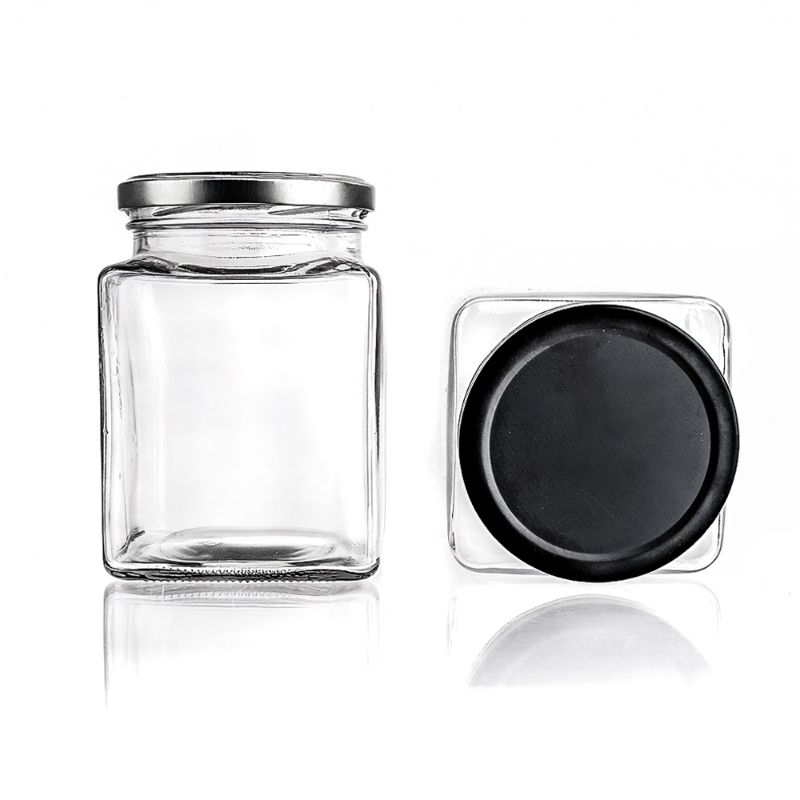
CTA image: a glass jar from the IDEA PACKAGE range. Use the risk ranking to request the right sample, test report and quote.
Next step: Contact IDEA PACKAGE to request a sample, a quote and a pre-shipment test checklist for your jar format.
Contact: Tom, tom.ideabottle@gmail.com, +86 185-5501-9935, WhatsApp +86 185-5501-9935.
Address: 32nd Floor, Huiyan Anhui Center, 180 Changjiang Middle Road, Luyang District, Hefei City, Anhui Province, China. Website: www.ideabottles.com.