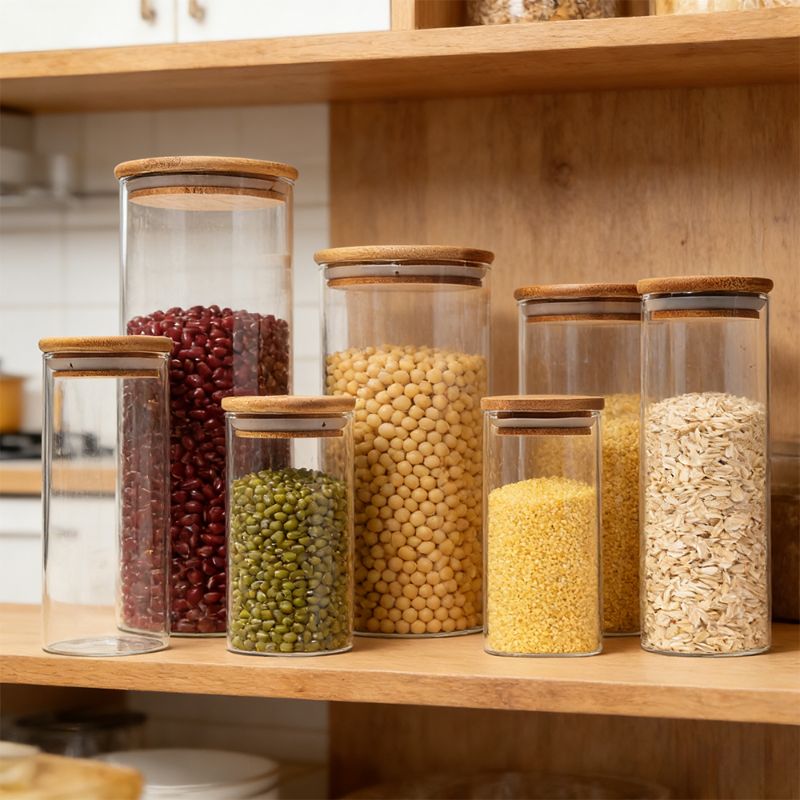
Glass Jar Basics: Choose by Fill and Closure, Not by Shape
Glass jars are usually bought by family, not by litre. Storage, Mason, honey, jam, coffee, pickle, spice, freezing, candle and cream jars look similar on a shelf, but they carry different fill, closure and heat requirements.
So the first procurement question is not decoration. It is: what fills the jar, how is it filled, and how is it sealed? A 500 ml honey jar and a 500 ml candle jar may share a shape family and still need different closure behaviour. In the IDEA PACKAGE glass jar-101 range, jars are supplied as a jar-and-lid unit — tinplate twist-off, aluminium, plastic, wooden or snap-on lids — in hexagonal, round, square and cylindrical shapes, from 200 ml to 1500 ml, in soda-lime or borosilicate glass.
Documentation follows the same logic. In the EU, glass food-contact compliance rests on framework Regulation (EC) No 1935/2004 and mandatory GMP under (EC) No 2023/2006; because there is no single EU-wide glass composition measure, suppliers are qualified by evidence rather than by one certificate.
A workable sequence for a first order: fix the fill weight and closure, confirm glass type and seal, then request the matching food-contact documentation — before comparing print or frosting options.
#GlassPackaging #PackagingSourcing #FoodPackaging