28mm PET Preform Sourcing: Specs, Compliance, and What Buyers Actually Get Wrong
What a 28mm PET Preform Really Decides for Your Bottle
A 28mm PET preform isn't just a raw component — it becomes the neck and thread of the finished container. That means it controls three things every buyer cares about: whether the cap seals properly, whether the blowing line runs without reject piles, and whether the finished bottle can legally contact drinking water, juice, or edible oil on the shelf.
If you're an importer, brand owner, bottler, or packaging distributor evaluating PET preform suppliers, the buying decision should come down to three verifiable things — not price alone: documented food-grade material, a tolerance-controlled neck and closure interface, and a manufacturing process that holds weight consistency batch after batch.
This guide lays out exactly what to verify, what evidence to request from a supplier, and where documented spec limits begin and end.

Three Places Where a 28mm Preform Order Falls Apart
Most sourcing headaches in this category don't come from resin price fluctuations. They trace back to three constraint points that get locked in long before a purchase order is signed.
1. The neck and cap are bought from different suppliers
Neck finish is a tolerance-controlled dimension. A preform that's off by a few tenths of a millimetre will blow into a bottle that leaks, caps at an angle, or fails a torque test outright. The fix sounds simple — buy preforms and caps as a matched set from one supplier — but plenty of buyers still source the closure separately and end up owning the interface risk themselves. If you do split the order, plan for dimensional spot checks and cap fitment tests with your actual closure before you commit to volume.
2. "Food grade" is a claim, not proof
Saying a preform is "food grade" doesn't make it documented. What you need is the resin category and the test report behind it — meaning a named regulation, a report number, an issuing laboratory, and a date. Without those four items, a compliance claim can't be verified or filed in a supplier record. Any supplier worth shortlisting should be able to produce this on request without hesitation.
3. Weight variation turns into rejects downstream
Preform weight directly controls wall thickness after blowing. Underweight units produce thin walls that fail during blow-moulding or collapse under stacking load. Overweight units waste resin and throw off the bottle's physical performance characteristics. The control that eliminates this variable is automatic checkweighing at the machine — units outside tolerance get rejected on the spot rather than passing downstream into your production line.
Why Food-Contact Compliance Has Become a Shortlisting Filter
The market context explains why documentation has shifted from paperwork formality to make-or-break screening criterion.
Fortune Business Insights projects the global PET preform market to reach USD 78.74 billion by 2034, with Asia Pacific already holding the largest regional share at USD 22.84 billion in 2024. Virgin PET still accounts for roughly 72% of material demand as of 2026, which means most preforms in circulation are moulded from virgin resin rather than recycled material.
Demand is also concentrating in applications where the container touches food directly. Mordor Intelligence reports that PET penetration in edible oil packaging exceeds 65% in developing economies, making oil bottle preforms a growth segment rather than a niche play. Every one of these applications pushes the compliance obligation upstream to the preform supplier — because the preform is the surface that contacts the product before the bottle is even blown.
Regulation is tightening in parallel. The EU Single Use Plastics Directive requires PET beverage bottles to contain at least 30% recycled content by 2030. For buyers, that has a concrete procurement implication: recycled-content capability is now a question to ask at the preform stage, not the bottle stage, because rPET capability lives with the preform converter.
What this means for a 28mm order: compliance documentation tells you which suppliers can be shortlisted today; recycled-content capability tells you which ones can still serve an EU-facing brand after 2030. Both answers should be locked down before a sample is blown.
The Specification Baseline: What a Documented Preform Must State
A preform specification is only worth the paper it's on if each line can be checked against a physical sample or a test document. Below is the spec range published for the PET Preform line from IDEA PACKAGE — covering neck sizes from 20mm through 32mm, with 28mm being the most widely traded size in the range.
Key specification points a buyer should verify:
- Material: Food-grade PET — confirm the resin category and the specific food-contact report covering your model, not just a general compliance statement.
- Neck sizes: 20mm, 24mm, 28mm, 30mm, 32mm available, plus custom millimetre dimensions. Verify that 28mm is confirmed on the technical drawing, not only in the catalogue description.
- Colour: Natural clear, green, blue, amber, and custom colours available. Approve colour against a physical standard sample before mass production begins — never against a screen image.
- Compatible caps: PET caps, PP caps, and aluminium caps. Run a cap fitment test with the actual closure you plan to use, not a generic equivalent.
- Stated properties: High transparency, high strength, easy blow-moulding. Verify with a blow trial on your own machine and mould, not the supplier's demo setup.
- Customization: Logo or printed branding; neck size, weight, colour, mould, packaging, and graphics all adjustable. Insist on a written specification and an approved pre-production sample.
- Samples: Available on request. Agree on sample quantity, freight terms, and evaluation criteria upfront.
Neck dimensions can also be specified as custom millimetre values, which matters when a brand uses a proprietary closure and can't accept a standard finish.
Compliance Evidence: What the Two Food-Contact Reports Actually Cover
The compliance position for the PET Preform product line — including model Water Bottle Preform-401 — rests on two independent food-contact plastic test reports issued in 2025. Both apply to the global market.
Report 1: Issued by TüV Rheinland/CCIC (Ningbo) Co., Ltd. on 2025-04-23, reference number 180327075a 001. This report sits on the EU framework and references Regulation (EC) No 1935/2004 and Commission Regulation (EU) No 10/2011. The tested scope covers sensorial assessment, overall migration, specific migration of 18 metals, primary aromatic amines, colourfastness, terephthalic and isophthalic acid, ethylene glycol, and antimony.
Report 2: Issued by Taizhou Customs Comprehensive Technology Service Center on 2025-06-25, reference number TZA25001027. This report sits on the Chinese GB framework and references GB 4806.7-2023 along with related GB test methods. The tested scope covers sensory, overall migration, KMnO? consumption, heavy metals (Pb), decolorization, and antimony (Sb).
Read together, these two reports cover the migration and residue parameters that show up most often in buyer questionnaires for drinking water, juice, and edible oil packaging. Having one report on the EU framework and one on the Chinese GB framework is particularly useful when a buyer needs to satisfy both a European brand owner and a domestic filling plant simultaneously.
Where the Documented Position Stops
Two limits need to be stated plainly because they affect how the evidence gets used in a supplier file.
First, these are food-contact test reports — not a recycled-content certificate. The stated manufacturing position is that preforms are moulded from food-grade virgin PET resin. A brand that must meet the EU 30% recycled-content target for 2030 should treat rPET availability as a separate question to confirm with the supplier, not a conclusion drawn from the migration reports.
Second, the published application guidance states that prolonged hot filling and extended contact with highly acidic or high-alcohol products should be avoided. If your product falls into those categories, confirm suitability in writing before ordering — don't assume that general food-contact compliance covers every filling condition. The stated application requirements for standard bottle projects are food grade, BPA-free, and stable wall thickness.
Step-by-Step: Qualifying a 28mm PET Preform Supplier
The sequence below follows the order in which constraints typically become irreversible. Each step produces a document or measurement that can be filed.
Step 1 — Fix the closure standard first. Confirm the neck finish (28mm or a custom millimetre dimension) and select the closure before the preform. Compatible caps include PET caps, PP caps, and aluminium caps. Buy preforms and caps as a matched set so one supplier owns the interface.
Step 2 — Request report numbers, not compliance claims. Ask for the report reference, issuing laboratory, issue date, and standards referenced. For this product line that means 180327075a 001 from TüV Rheinland/CCIC (Ningbo) and TZA25001027 from Taizhou Customs.
Step 3 — Agree the neck control method. Confirm that the neck finish is tolerance-controlled, that dimensional spot checks and cap fitment tests are part of routine production, then repeat the fitment test with your own closure.
Step 4 — Agree the weight control method. Confirm that automatic checkweighing rejects out-of-range units at the machine. This is the control that prevents thin-wall units from reaching your blowing line.
Step 5 — Approve colour and branding on a physical sample. Available colours are natural clear, green, blue, amber, and custom. Logo or printed branding is available. Approve against a retained physical standard, not a screen image.
Step 6 — Confirm the commercial envelope. MOQ is 10,000 pieces with price breaks at higher volumes. Monthly capacity is 500,000 pieces. Lead time is 15 days for 10,001–200,000 pieces, with delivery time negotiable above 200,000 pieces. Production runs in OEM/ODM mode.
Step 7 — Lock in inspection, Incoterms, and payment before production. Quality control is pre-shipment inspection — agree test items and AQL before the run starts. Quotation is available on FOB, CIF, or EXW terms. Payment is 30% T/T deposit before production with 70% T/T against a copy of the bill of lading.
Where 28mm Preforms Are Used
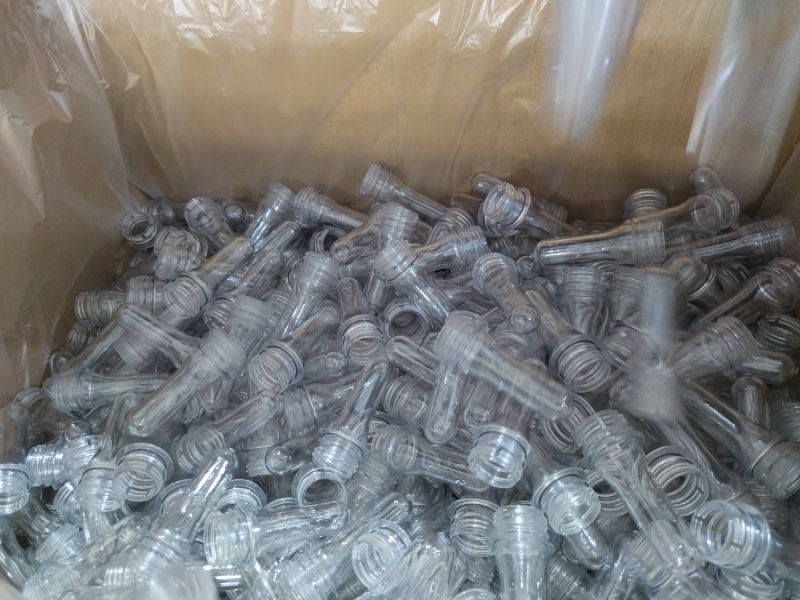
Preforms in this range are the raw material for blow-moulded bottles, processed on standard bottle blow-moulding machines paired with injection moulding upstream. The stated application industries cover food and beverage, drinking water, condiment, and daily chemical packaging — with bottle packaging as the core scenario.
Typical application scenarios include drinking water bottle packaging, edible oil bottle packaging, condiment packaging, and daily chemical packaging. Storage conditions for inbound material are straightforward: indoor warehouse storage at normal temperature in dry conditions.
What buyers have actually purchased — four reference cases show how the spec translates into repeat orders:
- Water treatment plant: Annual contract value USD 500,000, bottled water packaging. Result: stable production meeting food-grade requirements.
- Juice factory: USD 400,000 per year, bottled juice packaging. Result: stable filling performance with qualified product rate guaranteed.
- Oil processing plant: Annual contract value USD 300,000, bottled oil packaging. Result: stable filling performance with qualified product rate guaranteed.
- Health supplement factory: Annual contract value USD 500,000, bottled health supplement packaging. Result: stable filling performance with qualified product rate guaranteed.
In each case, what mattered wasn't a headline property — it was repeatability. The same neck dimension, the same weight, and the same food-contact documentation across successive shipments.
Commercial Constraints That Decide Feasibility
Capacity and lead time are constraints in the same sense as the neck dimension — a specification that can't be delivered on schedule isn't a usable specification.
- MOQ: 10,000 pieces, with price breaks at higher volumes.
- Monthly capacity: 500,000 pieces.
- Lead time: 15 days for 10,001–200,000 pieces; above 200,000 pieces delivery time is negotiable.
- Production mode: OEM/ODM, with customization across logo, packaging, graphic, neck size, weight, colour, and mould.
- Inspection: Pre-shipment inspection with report; test items and AQL agreed before production.
- Trade terms: FOB, CIF, or EXW.
- Payment: 30% T/T deposit before production, 70% T/T against a copy of the B/L.
- After-sales: Remote support.
Facility context matters for supply continuity. IDEA PACKAGE operates automated injection moulding lines with centralised material feeding and automated visual inspection, backed by a Hefei manufacturing headquarters and a Hong Kong-based international sales arm. The stated annual output is 10,000 tons, with approximately 80% of output exported globally.
Open Questions to Confirm Before You Order
A credible specification also states what it doesn't answer. Four points remain open and should be closed in writing during evaluation.
- Recycled content. Stated position is virgin food-grade PET. EU requires at least 30% recycled content in PET beverage bottles by 2030. Buyers with EU-facing brands should confirm the rPET roadmap separately.
- Filling conditions outside stated guidance. Prolonged hot filling and long contact with highly acidic or high-alcohol products fall outside the published recommendation and need written confirmation.
- Price benchmarking. No public price index is cited here. Pricing must come from a quotation tied to a defined specification, quantity, and Incoterms.
- Regional regulatory variation. The two reports cover the EU and Chinese GB frameworks. Markets with additional national requirements should be raised at enquiry stage.
Frequently Asked Questions
Are IDEA PACKAGE PET preforms compliant with EU food-contact rules?
The PET Preform product line, including model Water Bottle Preform-401, is covered by food-contact plastic test report 180327075a 001, issued on 2025-04-23 by TüV Rheinland/CCIC (Ningbo) Co., Ltd. under Regulation (EC) No 1935/2004 and Commission Regulation (EU) No 10/2011. The tested scope includes sensorial assessment, overall migration, specific migration of 18 metals, primary aromatic amines, colourfastness, terephthalic and isophthalic acid, ethylene glycol, and antimony. A second report, TZA25001027, was issued on 2025-06-25 by Taizhou Customs Comprehensive Technology Service Center and covers GB 4806.7-2023 with related GB test methods. Both reports apply to the global market.
Can the supplier deliver 28mm preforms with matching caps and custom branding?
Available neck sizes are 20mm, 24mm, 28mm, 30mm, and 32mm, with custom millimetre dimensions also possible. Compatible caps include PET caps, PP caps, and aluminium caps. Because neck finish is tolerance-controlled and verified with dimension spot checks and cap fitment tests, preforms and caps should be purchased as a matched set. Customization covers logo or printed branding, neck size, weight, colour, mould, packaging, and graphics. Available colours are natural clear, green, blue, amber, and custom.
What is the MOQ, and how is pricing structured?
MOQ is 10,000 pieces with price breaks at higher volumes. Monthly capacity is 500,000 pieces. Quotations are available on FOB, CIF, or EXW terms. Payment terms are 30% T/T deposit before production and 70% T/T against a copy of the bill of lading. Goods are released against a pre-shipment inspection report with test items and AQL agreed before the run.
Can I evaluate samples before committing to a bulk order?
Samples are available. An evaluation should cover neck dimension and cap fitment with your own closure, weight consistency, colour against a retained standard, and blow-moulding behaviour on your own machine and mould. Agree test items and AQL with the supplier before production begins, so the pre-shipment inspection report measures the same criteria used during sample review.
What is the lead time for a 28mm PET preform order?
Lead time is 15 days for orders between 10,001 and 200,000 pieces. Above 200,000 pieces, delivery time is negotiable. Production runs in OEM/ODM mode with pre-shipment inspection and remote after-sales support. To confirm a schedule against your filling plan, send the neck size, weight, colour, target quantity, and destination port.
Conclusion: Buy the Documented Specification, Not the Description
A 28mm PET preform purchase is decided by evidence that can be filed: a food-contact report with a number, an issuing laboratory, and a date; a neck dimension that is tolerance-controlled and confirmed by cap fitment testing; a weight control that rejects out-of-range units automatically; and a commercial envelope that states MOQ, lead time, and capacity without ambiguity. IDEA PACKAGE documents all four for its PET Preform range — and states its limits as clearly as its capabilities: virgin PET rather than recycled material, and no recommendation for prolonged hot filling or high-alcohol contact.
That combination is what a buyer in the evaluation stage needs to write a defensible supplier file. The specification, the reports, and the reference cases are all verifiable. The remaining questions are the ones only your own production line and your own target market can answer.
Next Step: Sample or Quotation
Send the neck size, preform weight, colour, target quantity, and destination port to receive a specification-matched quotation. Samples are available for cap fitment and blow trials.
Email: tom.ideabottle@gmail.com · Tel / WhatsApp: +86 185-5501-9935 · Website: https://www.ideabottles.com/