Aluminum Can Sourcing: Specs, Compliance and MOQ Limits
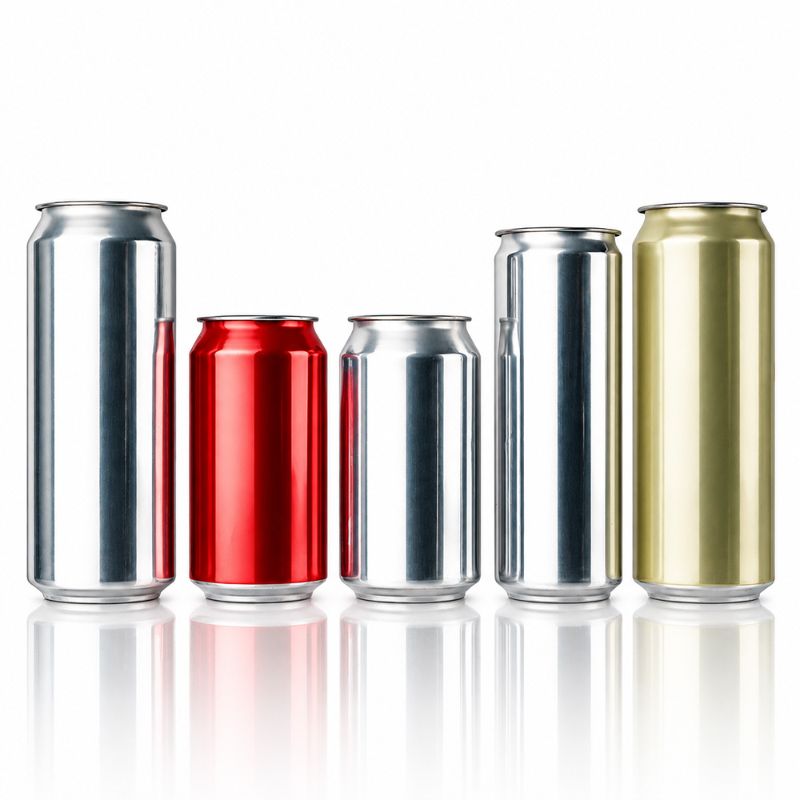
Aluminum can body from the IDEA PACKAGE metal packaging line, shown with decorative print.
An aluminum can program rarely fails at the negotiation table. It fails at one of four checkpoints: the food-contact documentation does not match the destination market, the can body and end do not fit the filling line, the order falls below the supplier's minimum quantity, or the delivery slot does not fit the production calendar. All four are verifiable before a purchase order is issued, and none of them can be repaired by a price concession afterwards.
Short answer: evaluate an aluminum can supplier against four documented constraints — food-contact compliance (BPA-free internal coating backed by a test report and batch-level Certificate of Analysis), dimensional specification (can type, capacity, 202# or 206# end size, SOT / EOE / full-open end), commercial envelope (MOQ of 100,000 pcs, FOB / CIF / EXW, 30% T/T deposit and 70% T/T against copy of B/L), and lead time (7 days for 1–10,000 pcs, 15 days for 10,001–500,000 pcs, negotiable above 500,000 pcs).
IDEA PACKAGE is the packaging brand of ANHUI IDEA TECHNOLOGY IMP&EXP Co., Ltd., a China-based packaging manufacturer and exporter founded in 2018 and headquartered in Hefei, Anhui Province. The company operates dedicated glass, plastic and metal packaging facilities and supplies aluminum cans, glass jars, bottles and caps to beverage, beer, food, personal care and condiment producers. Its metal packaging output is the subject of this guide, which is written for procurement managers, importers, brand owners and beverage plants currently in the research and evaluation stage.
Why "Metal Can" Is a Category, Not a Specification
In everyday trade language the label "tin can" is often applied loosely to metal food and beverage containers, and search phrases such as aluminum tin can or tin can packaging routinely lead buyers to aluminum-bodied cans. For procurement purposes the distinction that matters is the body material, because aluminum and tinplate differ in weight, forming behavior and line compatibility. Everything described in this guide refers to aluminum cans: a food-grade aluminum alloy body with a seamed easy-open end.
The practical difficulty is that a quotation sheet answers none of the questions that decide whether a container works. Four gaps sit between a price and a production-ready can.
Gap 1 — Body and material terminology
A request written as "beverage can, 330 ml, standard" leaves the alloy, coating and end format undefined. Two suppliers can quote the same sentence and deliver containers that behave differently on the same seamer.
Gap 2 — The end and the seaming line
The can end is a separate specification from the can body. End diameter (202# or 206#) and opening format (SOT, EOE or full-open end) determine whether a filling line can run the container at its designed speed. A can that seals correctly in a manual trial can still fail on an automatic high-speed filling and seaming line.
Gap 3 — Internal coating and food-contact evidence
For any beverage or food application, the internal coating is a food-contact surface. The buyer needs two things that are often conflated: a coating specification (for example, BPA-free) and the documentation that proves the specification holds — a test report, a batch-level Certificate of Analysis, and a sealed retention sample system.
Gap 4 — The commercial envelope
Minimum order quantity, Incoterms, payment milestones and inspection method are not administrative details. They determine whether a specification can be bought at all, in the volume the buyer actually needs, on a schedule that matches a filling calendar.
Where Aluminum Cans Sit in Beverage Packaging Today
Aluminum cans serve beer, carbonated drinks, fruit juice, coffee, functional drinks and canned food. The format carries three structural advantages that keep it central to beverage packaging: it is lightweight relative to rigid glass, it is fully recyclable, and it provides airtight containment that preserves flavor and carbonation.
Those advantages only convert into a working package when the container is matched to a filling environment. The operating condition for a typical aluminum can program is an indoor production line at normal temperature, paired with an automatic high-speed filling and seaming line and matched equipment covering the can filling machine, the seamer and the ink printing machine. The special requirements attached to that environment are consistent across applications: BPA-free inner coating, food-grade construction and high airtightness.
Two shifts in buyer behavior follow from that. First, food-contact documentation has moved from an optional annex to a routine part of the specification package — a supplier who cannot produce a coating test report and a batch Certificate of Analysis is now difficult to onboard, regardless of price. Second, buyers increasingly evaluate suppliers on whether the supplier can hold a specification across a production run, not on whether the supplier can describe one in a catalog. That is a capability question, and it is answered with inspection records, not adjectives.
How IDEA PACKAGE Structures an Aluminum Can Program
The IDEA PACKAGE metal line is organized around the four constraints above, so that each one has an owner, a document and a default. The specification envelope is fixed first, then compliance evidence, then decoration, then the commercial terms that make the envelope buyable.
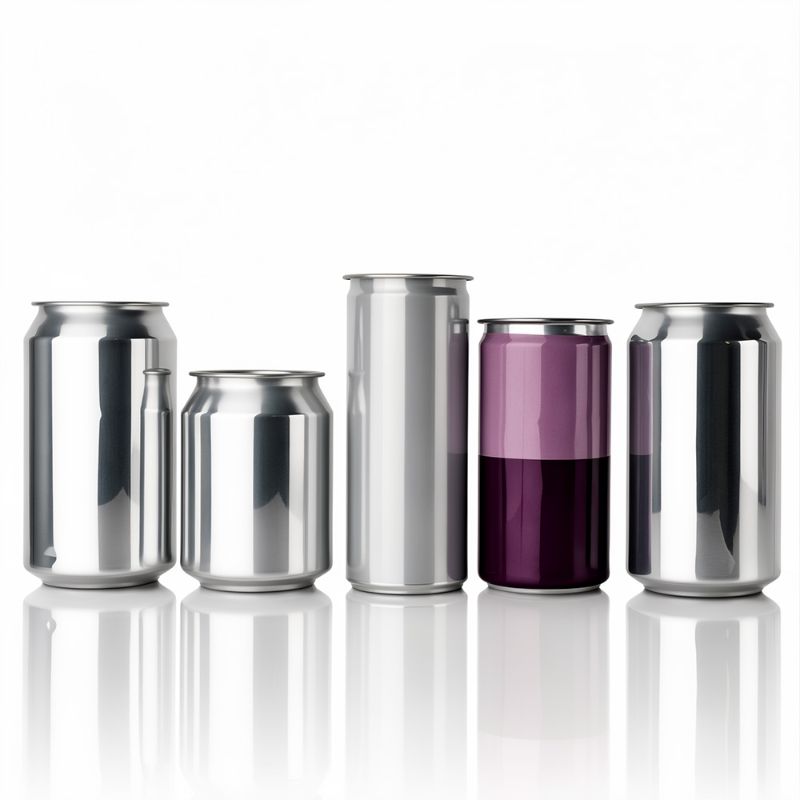
Aluminum can formats span Standard, Sleek and Slim can types with multiple capacity and end options.
Specification envelope
The published aluminum can specification covers can types in Slim, Sleek and Standard formats, with capacities including 250 ml, 330 ml, 355 ml, 473 ml and 500 ml, and standardized can end sizes of 202# and 206# measured at lid diameter. The body is food-grade aluminum alloy with a BPA-free internal coating. Appearance options run from natural aluminum through white-base printing to full-color printing, and surface finishing can be handled by UV printing, shrink sleeve or self-adhesive label. Lid types available are SOT (stay-on tab), EOE (easy-open end) and full-open end. Customization covers logo, matte or glossy finish, size and capacity.
Food-contact documentation
Compliance is the constraint that disqualifies a supplier fastest, so it is worth stating exactly what exists. The aluminum can coating has been tested for bisphenol A under report number ZTS25012103ERC, issued on 12 February 2025 by Shenzhen ZTS Testing Service Co., Ltd. The test scope is Bisphenol A (BPA) testing of the aluminum can coating against Regulation (EC) No 1935/2004, (EU) 2018/213, (EU) 10/2011 and CEN/TS 13130-13:2005. The market coverage of that report is recorded as global.
Behind the report sit three production controls: the internal lining is BPA-free by specification, incoming material batches are checked against a Certificate of Analysis before production, and a batch retention sample management system is maintained. Seal integrity is controlled separately — every unit passes a 100% airtightness test before shipment, and coating adhesion is verified by adhesion testing rather than by visual inspection alone.
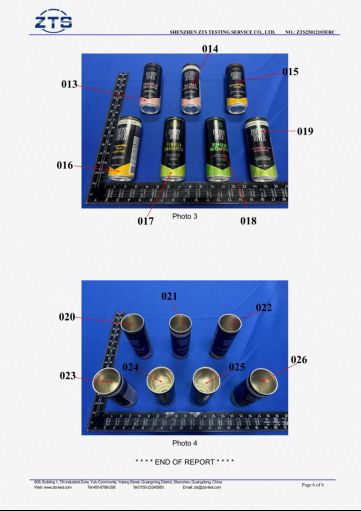
Bisphenol A (BPA) test report ZTS25012103ERC covering aluminum can coating, issued 12 February 2025.
Ends and opening systems
End formats are specified separately from the body because they carry their own performance requirements. The IDEA PACKAGE aluminum can program supplies easy-open end variants — Standard, Wide, High and Special — with smooth-opening pull tabs, robust rivet structures and integrated sealing gaskets for reliable, airtight performance. Combined with burr-free can openings and solid base formation, this is the part of the specification that protects the consumer experience and the filling line simultaneously.
Decoration and artwork workflow
Surface decoration is where brand requirements most often collide with production reality. Full-can printing supports client logos and custom graphics, and finish options include matte, glossy and metallic effects. The company also provides graphic design and prototyping support, which matters when a buyer needs to confirm artwork registration before committing to a production run rather than after.
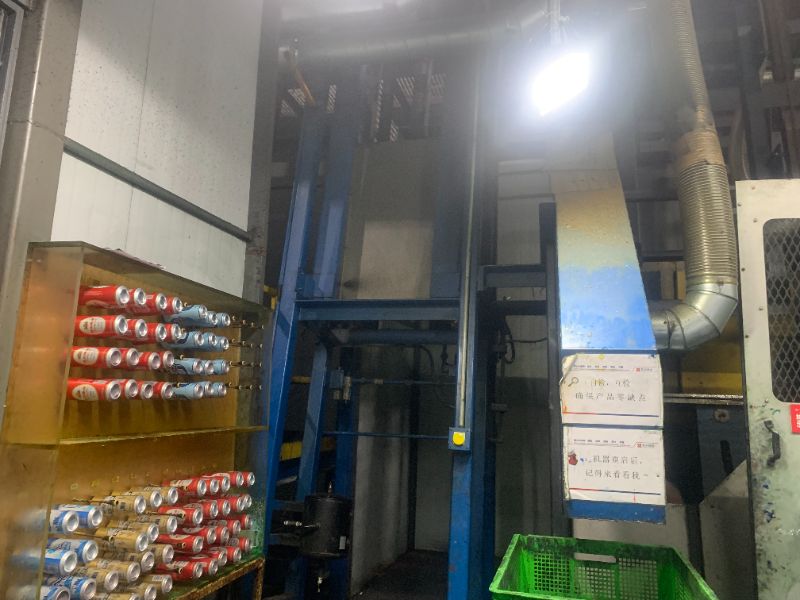
Printing workshop for aluminum can decoration, part of the IDEA PACKAGE metal packaging operation.
Production scale, MOQ and lead time
Monthly capacity on the aluminum can line is 300,000,000 pcs per month, which is what makes a 100,000-piece minimum order quantity commercially workable. Lead time is banded by order size rather than quoted as a single figure: 7 days for 1–10,000 pcs, 15 days for 10,001–500,000 pcs, and negotiable above 500,000 pcs. Production mode covers both OEM and ODM, with customization across logo, packaging, graphic, printing, color, coating, size and capacity.
Quality control and export handling
Pre-shipment inspection is the default quality gate, with the inspection report supplied before goods leave. Export packaging uses cartons and pallets, and the shipping program supports large-scale wholesale with global delivery. After-sales support is provided remotely. At company level the operation is ISO 9001, FDA and CE certified, exports to more than 150 countries and regions, and serves more than 2,500 clients worldwide through Rocsun Eco, its Hong Kong-based international sales and marketing hub.
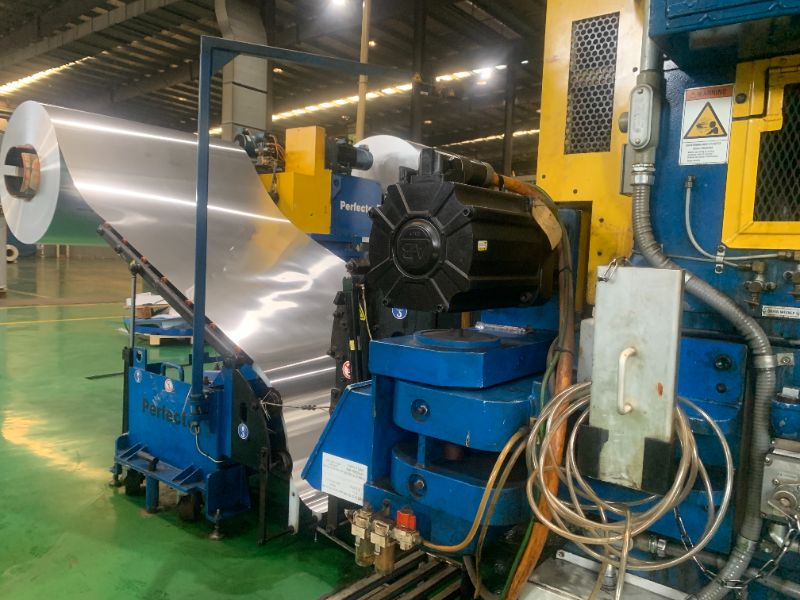
Aluminum coil being stamped at the start of the can forming process.
A Six-Step Verification Sequence for Aluminum Can Buyers
The sequence below is written for the evaluation stage. Each step produces a document or a decision that the next step depends on, which prevents the common pattern of agreeing a price and then discovering a specification mismatch weeks later.
Step 1 — Fix the product and the line interface
Start with the filling environment, not the catalog. Confirm the can type (Standard, Sleek or Slim), the capacity from the available range of 250 ml, 330 ml, 355 ml, 473 ml and 500 ml, and the seamer's end size requirement (202# or 206#). Record the line type the can will run on — the reference environment is an automatic high-speed filling and seaming line with a can filling machine, a seamer and an ink printing machine. Any deviation from those three interfaces should be resolved before pricing is requested.
Step 2 — Define the food-contact requirement and the evidence that proves it
State the coating requirement explicitly as BPA-free, then request the supporting documents: the coating test report (report number ZTS25012103ERC, issued 12 February 2025 by Shenzhen ZTS Testing Service Co., Ltd., covering Regulation (EC) No 1935/2004, (EU) 2018/213, (EU) 10/2011 and CEN/TS 13130-13:2005), confirmation of Certificate of Analysis checking on incoming material batches, and confirmation that batch retention samples are kept. A supplier who can only answer "yes, food grade" has not answered the question.
Step 3 — Select the end format
Decide between SOT, EOE and full-open end based on how the product is consumed, and match that decision to the end variants the supplier actually produces: Standard, Wide, High and Special easy-open ends. Confirm that the chosen end is available at the 202# or 206# diameter the line requires and that sealing gaskets and rivet structures meet the airtightness requirement.
Step 4 — Lock decoration and the artwork workflow
Choose the decoration route — UV printing, shrink sleeve or self-adhesive label — and the finish (matte, glossy or metallic). Then fix the approval sequence: artwork submission, proofing, and sign-off before mass production. Buyers who skip the proofing step usually absorb the cost at the printing stage, where corrections are slowest and most expensive.
Step 5 — Convert the specification into a commercial envelope
Confirm that the order volume clears the 100,000 pcs minimum for standard mass-production pricing. Select the Incoterm — FOB, CIF and EXW are all available — and agree the payment structure: 30% T/T deposit before production, 70% T/T against a copy of the B/L. Where a buyer intends to scale, note that capacity of 300,000,000 pcs per month removes the volume ceiling as a practical constraint.
Step 6 — Set inspection and acceptance before the goods move
Inspection is agreed before production starts, not after it finishes: test items and AQL are fixed in advance, and the pre-shipment test is carried out before goods leave with the test report provided. For any buyer making a first order, this is the step that converts a supplier's claim into a record.
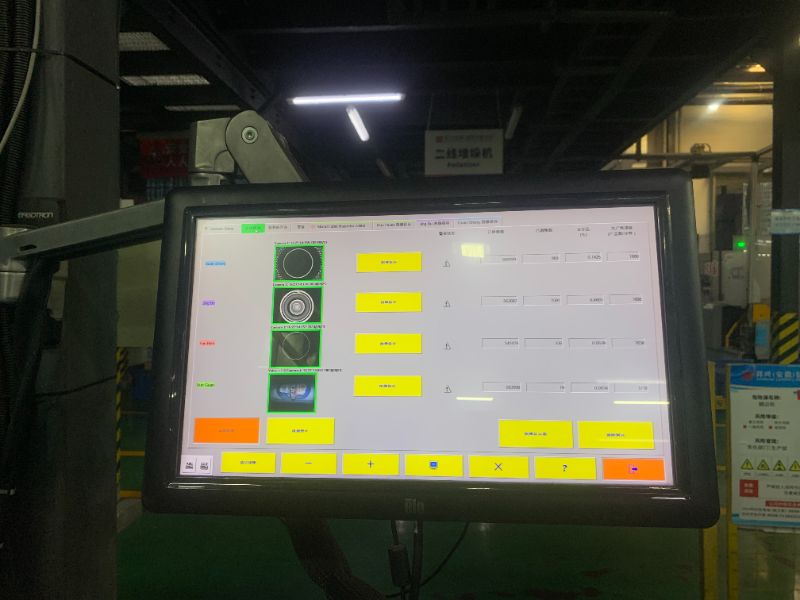
Finished aluminum cans passing through compliance inspection before shipment.
Where These Constraints Matter Most
The same four constraints behave differently across applications, because the risk that matters most changes with the product inside the can.
Beer can programs
Beer is the most pressure-sensitive of the common applications. Base formation and end integrity carry most of the risk, and the reference requirement — high airtightness combined with a BPA-free inner coating — is the minimum rather than a premium option. A US brewery account on the IDEA PACKAGE aluminum can line, packaging canned beer, runs at an annual contract value of USD 1.2 million, with the recorded result being stable production operation that meets food-grade packaging requirements.
Soda and carbonated soft drinks
Carbonated drinks combine internal pressure with high line speed. Buyers in this segment should test the can type and end combination against the actual seamer before scaling, because a container that seals correctly in a trial can behave differently under continuous production.
Functional and energy drinks
Functional drink formats put more weight on decoration and on short runs per SKU. The combination of full-can printing, shrink sleeve and self-adhesive label options allows several products to share a single body specification while remaining visually distinct. A beverage plant in the UAE runs an account at an annual contract value of USD 500,000 on this line, and a beverage plant in Kazakhstan runs a further USD 500,000 account, both with stable production operation meeting food-grade requirements.
Coffee, juice and canned fruit wine
Ready-to-drink coffee, fruit juice and canned fruit wine place more emphasis on coating integrity and corrosion resistance, because the product stays in contact with the internal surface longer or is more aggressive. Fruit winery accounts in the UK and Korea illustrate the pattern: USD 800,000 and USD 400,000 in annual contract value respectively, both packaging canned fruit wine, with food grade, good sealing performance and corrosion resistance recorded as the deciding characteristics.
Canned food and general metal can packaging
Where the buyer's search starts from tin can packaging rather than from beverage terminology, the evaluation logic is the same: confirm the body material, confirm the food-contact documentation, then confirm the end and the line interface. The material question should be answered first, since aluminum and tinplate are not interchangeable on an existing line.
Specification and Constraint Matrix
The table below consolidates the published aluminum can specification against the confirmation a buyer should obtain for each dimension. Every value in the specification column is taken from the IDEA PACKAGE aluminum can data; the confirmation column states what must be resolved before ordering.
| Specification dimension | Available options | What the buyer must confirm |
| Can type | Slim, Sleek, Standard | Which type the filling line and the shelf presentation require |
| Capacity | 250 ml, 330 ml, 355 ml, 473 ml, 500 ml | Exact fill volume and headspace for the product |
| Can end size | 202#, 206# (lid diameter) | End diameter accepted by the existing seamer |
| Body material | Food-grade aluminum alloy | Material confirmation against the product's corrosion profile |
| Internal coating | BPA-free | Test report and Certificate of Analysis evidence, not a verbal claim |
| Lid type | SOT (stay-on tab), EOE (easy-open end), full-open end | Opening format matched to the consumption occasion |
| Appearance | Natural aluminum, white-base printing, full-color printing | Base coat and print coverage agreed at proofing stage |
| Surface finish | UV printing, shrink sleeve, self-adhesive label | Decoration route compatible with the line and with recycling claims |
| Customization | Logo, matte / glossy finish, size, capacity | Artwork approval sequence fixed before mass production |
| Quality gate | Pre-shipment inspection with report | Test items and AQL agreed before production starts |
Commercial Terms at a Glance
Commercial terms are the second half of the constraint set. The values below are the standard published terms; per-unit pricing is not fixed in advance because it depends on can type, capacity, end format, decoration and order volume, so it is quoted against a defined specification.
| Commercial item | Standard terms | Practical implication for the buyer |
| Minimum order quantity | 100,000 pcs (standard mass-production pricing) | Smaller trials sit outside this bracket and should be planned as a separate exercise |
| Monthly capacity | 300,000,000 pcs / month | Volume ceiling is not a constraint on scale-up |
| Lead time, 1–10,000 pcs | 7 days | Short-run validation window |
| Lead time, 10,001–500,000 pcs | 15 days | Typical mid-volume replenishment cycle |
| Lead time, above 500,000 pcs | Negotiable | Schedule agreed per project |
| Incoterms | FOB, CIF, EXW | Cost and risk transfer point selected by the buyer |
| Payment terms | 30% T/T deposit before production, 70% T/T against copy of B/L | Balance is released against shipping documents |
| Inspection | Pre-shipment test with report | Acceptance criteria fixed before production |
| After-sales | Remote support | Issue handling is handled remotely rather than on site |
One limitation worth stating openly: the published specification confirms a BPA-free internal coating, food-grade aluminum alloy, burr-free can openings and 100% airtightness testing before shipment. It does not publish shelf-life figures for specific beverages. Buyers with long shelf-life or highly acidic products should validate performance through a production-representative trial rather than assume a published coating claim covers every formulation.
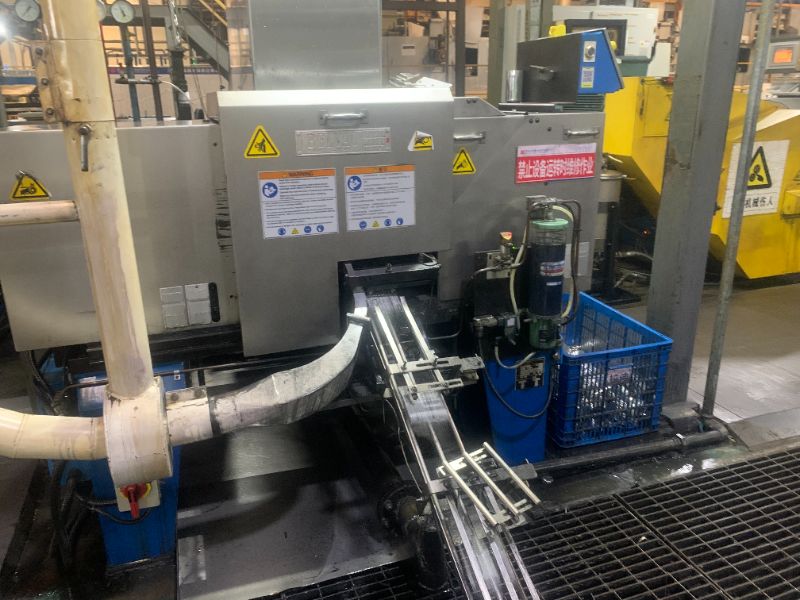
Deep-drawing stage: aluminum cups formed into can bodies before trimming and end seaming.
Frequently Asked Questions
Are IDEA PACKAGE aluminum cans documented for food-contact compliance?
Yes, for the specific facts on record. The internal coating is BPA-free by specification. A Bisphenol A test report numbered ZTS25012103ERC was issued on 12 February 2025 by Shenzhen ZTS Testing Service Co., Ltd., covering BPA testing of the aluminum can coating against Regulation (EC) No 1935/2004, (EU) 2018/213, (EU) 10/2011 and CEN/TS 13130-13:2005, with global market coverage recorded. Incoming material batches are checked against a Certificate of Analysis before production, a batch retention sample management system is maintained, every unit passes a 100% airtightness test before shipment, and coating adhesion is verified by adhesion testing. At company level the operation holds ISO 9001, FDA and CE certification.
Which can types, capacities and end formats can be ordered?
Aluminum cans are available in Slim, Sleek and Standard can types, with capacities including 250 ml, 330 ml, 355 ml, 473 ml and 500 ml, and standardized can end sizes of 202# and 206# measured at lid diameter. The body is food-grade aluminum alloy with a BPA-free internal coating. Lid options are SOT (stay-on tab), EOE (easy-open end) and full-open end. Decoration can be applied by UV printing, shrink sleeve or self-adhesive label, with natural aluminum, white-base printing or full-color printing as appearance options and matte or glossy finishes available. Logo, size and capacity are all customizable, and both OEM and ODM production modes are supported.
What is the minimum order quantity and how are commercial terms structured?
The minimum order quantity is 100,000 pcs for standard mass-production pricing. FOB, CIF and EXW terms are all available. Payment is structured as a 30% T/T deposit before production and 70% T/T against a copy of the B/L. Goods are inspected by pre-shipment test before they leave, with the test report provided, and the test items and AQL should be agreed with the supplier before production starts. Per-unit pricing is not published in advance because it is set by can type, capacity, end format, decoration and order volume.
Can a buyer validate the product before committing to a large production run?
Yes, through the short lead-time bracket. Orders of 1–10,000 pcs are scheduled at 7 days, which is the practical window for confirming body, end and print behavior before scaling. The 10,001–500,000 pcs bracket runs at 15 days, and orders above 500,000 pcs are scheduled by negotiation. Because inspection is a pre-shipment test rather than a post-delivery claim, a buyer can define the test items and AQL before the first production run and apply the same criteria at every subsequent run.
What lead time and shipping support apply to volume orders?
Lead time is quoted by order bracket: 7 days for 1–10,000 pcs, 15 days for 10,001–500,000 pcs, and negotiable above 500,000 pcs, against a monthly capacity of 300,000,000 pcs. Export packaging uses cartons and pallets, and the shipping program supports large-scale wholesale with global delivery. After-sales support is provided remotely. To confirm a specification and request a quotation, contact IDEA PACKAGE by email at tom.ideabottle@gmail.com, by phone or WhatsApp at +86 185-5501-9935, or request the product catalog and sample discussion through ideabottles.com.
Conclusion: Buy the Document, Not the Description
Aluminum can sourcing is decided by four constraints that can each be verified in advance: a BPA-free coating backed by a named test report and batch-level Certificate of Analysis, a body and end specification that matches the filling line at 202# or 206# with SOT, EOE or full-open ends, a commercial envelope built around a 100,000 pcs MOQ with FOB, CIF or EXW terms and 30/70 T/T payment, and a lead time that scales from 7 days at low volume to a negotiated schedule above 500,000 pcs.
IDEA PACKAGE, the packaging brand of ANHUI IDEA TECHNOLOGY IMP&EXP Co., Ltd., operates against that structure from its base in Hefei, Anhui Province, with an aluminum can line capacity of 300,000,000 pcs per month, 15 engineers in the R&D team, ISO 9001, FDA and CE certification, and export coverage across more than 150 countries and regions. The simplest way to test whether a supplier can hold a specification is to ask for the documents behind it.
Next step
If you are evaluating aluminum cans for a beer, soda, functional drink, coffee or juice program, request a specification-matched quotation and the compliance document set before committing to volume. Contact Tom at tom.ideabottle@gmail.com or WhatsApp +86 185-5501-9935.
ANHUI IDEA TECHNOLOGY IMP&EXP Co., Ltd. · 32nd Floor, Huiyan Anhui Center, 180 Changjiang Middle Road, Luyang District, Hefei City, Anhui Province, China · Founded 2018 · www.ideabottles.com
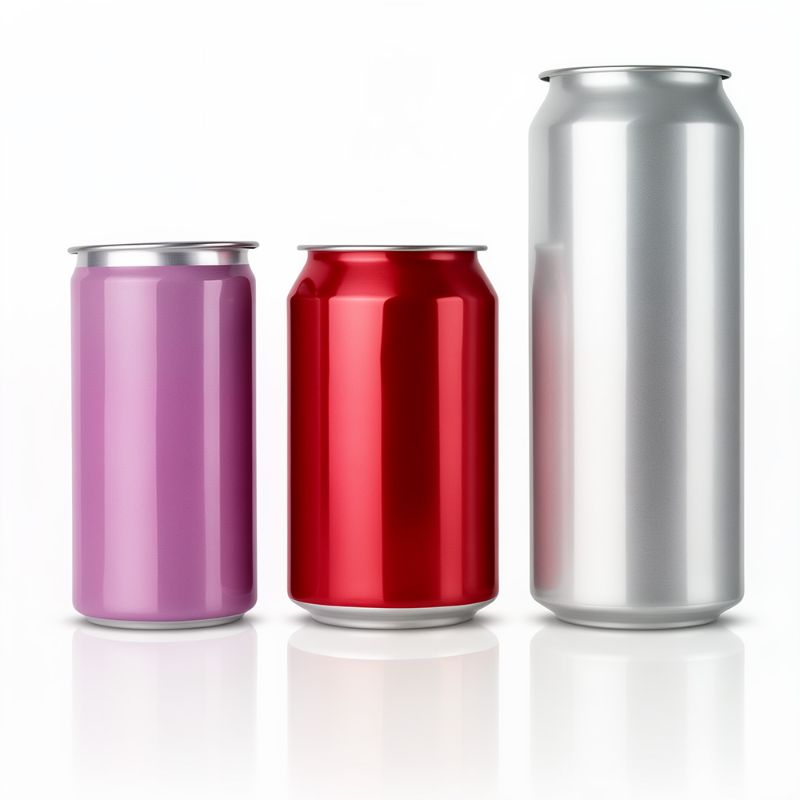
Custom-decorated aluminum can produced on the IDEA PACKAGE metal packaging line.