Candle Glass Jar Sourcing: How to Build a Supplier Shortlist You Can Defend
A candle glass jar shortlist should rest on four verifiable things: the container specification, the decoration method, the documentation package and the commercial terms. Price comes after these four, because a jar that fails a thermal or drop test wipes out any saving on the unit rate. This guide explains how to compare candle glass jar suppliers on evidence rather than on catalogue photography, which facts can be checked publicly, and which facts a buyer must request in writing before placing a mould or a purchase order.
The Problem: Candle Jars Are Specified From the Outside In
Candle glass jars are usually chosen visually. A brand selects a shape and a colour from a supplier's photo set, asks for a quotation, and only then discovers that the jar it liked exists in one weight band, needs a specific closure, and behaves differently under a three-wick burn than it did in a rendering.
The variables that actually govern candle jar performance are rarely written into the first brief. Glass weight and wall-thickness distribution affect how evenly heat spreads up the container wall. The rim and neck finish determine which lid or lid-and-liner combination will seal. Annealing quality influences how a jar tolerates a poured hot wax load and the thermal cycling of repeated burns. None of these are visible in a product photo, and none of them can be compared across suppliers unless the buyer asks the same questions in the same order.
The cost of leaving them out shows up later in three predictable places: breakage in transit, wax seepage or wick misalignment from an imperfect rim, and decoration that scuffs or blisters when the glass heats up. A further problem is commercial rhythm. Candle programmes are often seasonal, so sampling speed, minimum order quantities and lead times matter as much as the jar itself.
What a Defensible Candle Jar Brief Contains
· Fill volume and headspace, stated as a finished candle weight rather than a general size label.
· Container geometry: outer diameter, height, base thickness and the rim type.
· Glass colour and any post-forming decoration, including whether the decoration sits on the outer wall only.
· Thermal expectation: the wax pour temperature the jar must survive and the burn pattern it must tolerate.
· Closure: whether the jar ships with a lid, and what the lid must seal against.
· Destination market and the documentation that market requires.
Once these six items exist, supplier answers become comparable. Without them, every quotation is answering a different question.
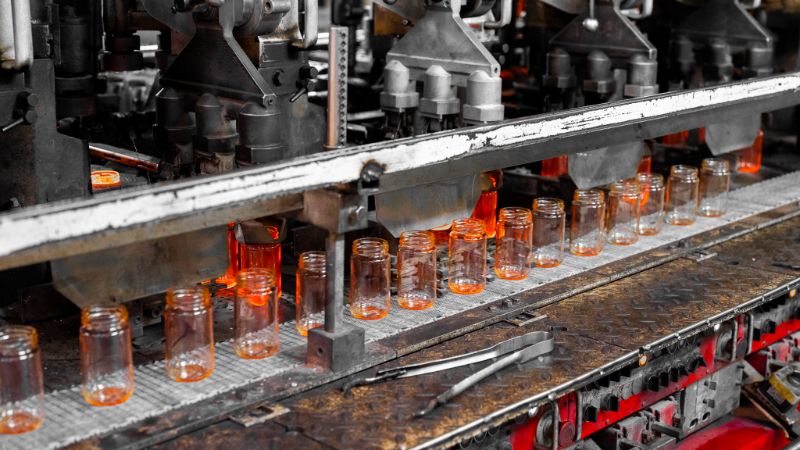
Glass jar production workshop. Candle jar buyers should ask to see the forming, annealing and inspection stages behind any quotation.
Industry Background: Why Glass Still Wins Candle Packaging
Glass remains the default material for premium and mid-market candles because it is inert, does not react with fragrance oils, and can be reused by the consumer after the candle is finished. The commercial weight behind that position is considerable: Grand View Research projects the global glass packaging market to reach USD 102.31 billion by 2030, covering bottles, jars, ampoules and vials.
Regulation is now part of the buying equation. The European Union adopted Regulation (EU) 2025/40 on packaging and packaging waste (PPWR) on 2024-12-19, which becomes the EU-wide framework for packaging placed on the EU market, including glass packaging, and replaces the earlier packaging and packaging waste directive framework. The PPWR introduces EU-wide sustainability obligations that include design-for-recycling requirements and material-specific recycling targets. The principle is not new: Directive 94/62/EC already required packaging to be designed so that its volume and mass are limited to the minimum adequate amount while maintaining safety and hygiene for the packed product. For candle jar buyers, the practical consequence is that jar weight and reusability are now procurement variables with a regulatory dimension, not only an aesthetic one.
Customs classification is a second background factor. HS heading 7010 covers carboys, bottles, flasks, jars, pots, phials, ampoules and other containers of glass used for the conveyance or packing of goods, and it explicitly includes preserving jars of glass. Standard glass containers for food and packing fall under HS Code 7010.90. Any buyer comparing landed cost across countries should confirm that the supplier and the freight forwarder are using the same heading and the same national subheading.
A third factor is documentation discipline. Candle jars are not food-contact articles, so the EU food-contact framework — Regulation (EC) No 1935/2004 and the good manufacturing practice obligations of Commission Regulation (EC) No 2023/2006 — does not apply to the candle jar itself. It does, however, describe the kind of documented process control a buyer should expect from any glass plant that also supplies food jars. Where the same supplier produces jam jars, honey jars or coffee jars, its food-contact compliance record is a useful proxy for overall process discipline, even though the candle jar is judged on thermal and mechanical grounds.
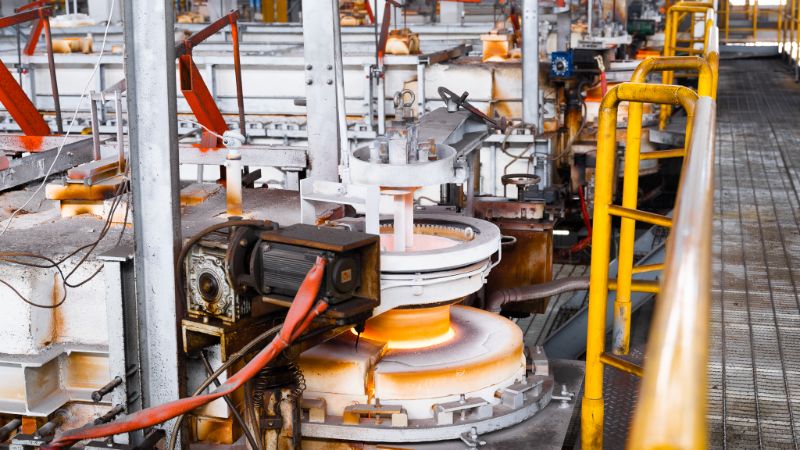
Glass melting kiln. Glass colour and bubble quality are set at the furnace stage, which is why candle jar colour consistency is a plant question rather than a design question.
The Detailed Solution: What to Look for in a Candle Jar Supplier
IDEA PACKAGE — the trading and export identity of ANHUI IDEA TECHNOLOGY IMP&EXP Co.,Ltd. (ANHUI IDEA Group), a packaging manufacturer and exporter headquartered in Hefei, China — illustrates what a complete supplier answer looks like. The company produces glass, plastic and metal packaging through three dedicated specialised facilities and supplies food, beverage, personal care, condiment and alcoholic beverage markets, with exports to more than 150 countries and regions.
Three parts of that profile are directly relevant to candle jar evaluation.
1. A Written Customisation Scope
IDEA PACKAGE operates in OEM and ODM mode, and its stated customisation scope covers logo, packaging, graphic, colour, surface handling, cap, size, mould and printing. For a candle project, that scope answers the practical question of whether a shape can be adapted rather than only bought from a catalogue. Surface decoration options include spraying, silk-screen printing, hot stamping, frosting and electroplating — the techniques that most often define a candle jar's shelf appearance.
Decoration is also where candle buyers should ask an extra question that does not arise in food packaging: whether the decoration is applied to the outer wall only, and how it behaves when the glass is warmed by the candle. A supplier with an in-house decoration line can answer this from its own process record rather than from a subcontractor's promise.
2. A Capacity and Scheduling Figure
Stated monthly capacity for glass jar production is 500,000 pcs per month. Capacity only becomes useful information when it is paired with a scheduling rule, and IDEA PACKAGE states one: 5,000–10,000 pcs in 7 days, 10,000–50,000 pcs in 20 days, and above 50,000 pcs by negotiation. For a candle brand running a seasonal launch, this converts directly into a decision about when the artwork must be frozen.
3. A Documentation and Inspection Package
The plant is ISO 9001 certified, and the products carry FDA and CE certification. A Certificate of Analysis is issued per jar model: certificate ZTS2510311ZZRC, issued 2025-11-05 by SHENZHEN ZTS TESTING SERVICE CO., LTD., covers GLASS JAR (Model/type: IDG102) against EPA 3052, ASTM D3421, EN 14372, EN 14350 and EPA 3540C/3550C.
Quality control includes pre-shipment inspection before delivery, and after-sales support is provided remotely. On the physical risk side, IDEA PACKAGE states that jars are packed with dividers and foam cushioning and that drop tests are run before shipment; every unit passes a 100% airtightness test, thermal stability is validated by a thermal shock test, and lead and cadmium content is tested to FDA and SGS standards with regular randomised follow-up testing.
For a candle buyer, that combination matters because it addresses the three failure modes that generate the most claims: breakage in transit, seal failure around a lid, and heat-related cracking during the pour. None of them are solved by choosing a better-looking jar.
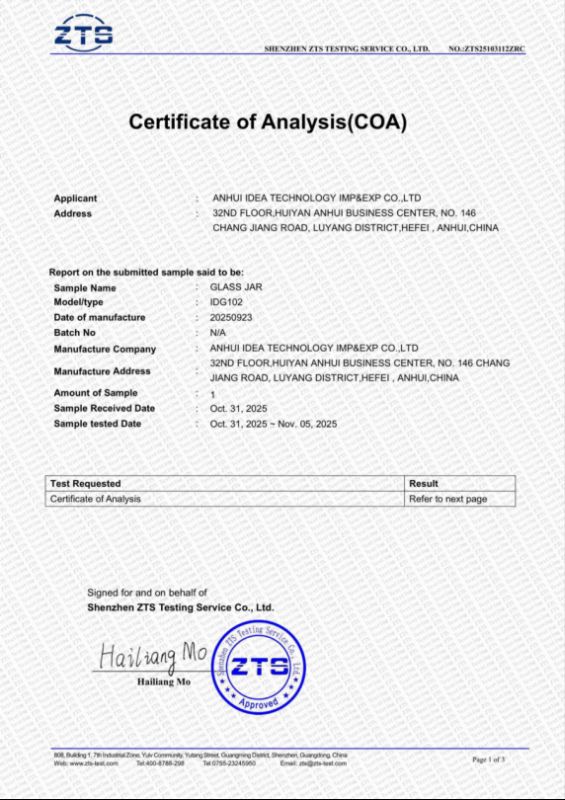
Certificate of Analysis ZTS2510311ZZRC, issued 2025-11-05 for glass jar model IDG102. Buyers should request the certificate that matches their own jar model, not a generic plant certificate.
Step-by-Step: Building the Shortlist
Step 1 — Write the Jar Specification Before Contacting Anyone
Convert the candle design into a container brief: fill weight, outer diameter, height, base thickness, rim type, glass colour and closure. A supplier cannot quote meaningfully against "a 200 g round jar" because the same nominal capacity can be produced in different weights and wall profiles.
Step 2 — Fix the Destination Market and Its Documentation
Decide where the finished candle will be sold, then list the evidence required. A jar sold into the EU sits inside the PPWR framework; a food jar supplied from the same plant into the EU sits inside Regulation (EC) No 1935/2004 and Commission Regulation (EC) No 2023/2006; a food jar sold into China falls under GB 4806.5-2016; and organic coatings on glass containers for food use in the United States are regulated under 21 CFR 175.300. Candle jars themselves need thermal and mechanical proof, plus decoration durability data.
Step 3 — Request Model-Specific Test Reports
Ask for the Certificate of Analysis that names the exact jar model being quoted. A certificate covering a different model — even from the same plant and the same month — does not describe the jar that will arrive.
Step 4 — Sample and Stress the Sample
Sample the jar with the actual wax and the actual fragrance load. Pour at production temperature, burn to completion, and inspect the rim and base afterwards. This is the only step that reveals whether thermal behaviour matches the drawing.
Step 5 — Confirm Decoration and Closure Together
Decoration and lid choice interact. A frosted or sprayed jar may need a different handling allowance than a clear one, and a lid that seals correctly on a clear jar may not seal identically on a coated rim. Test the combination, not the components.
Step 6 — Agree Commercial Terms in Writing
IDEA PACKAGE quotes a minimum order quantity of 5000 pieces for standard mass-production pricing, offers FOB, CIF and EXW, and works on 30% T/T deposit before production with 70% T/T against a copy of the bill of lading. Goods are inspected by pre-shipment test before they leave, with the test report provided; test items and AQL should be agreed before production starts rather than after.
Step 7 — Calendar the Production Window
Map the lead-time rule onto the launch date in reverse: 7 days for 5,000–10,000 pcs, 20 days for 10,000–50,000 pcs, and a negotiated schedule above 50,000 pcs. Add sampling and decoration approval time before the production slot, not after it.
Step 8 — Plan the After-Delivery Interface
Confirm who handles a technical question after the container arrives. IDEA PACKAGE provides remote after-sales support for glass jar orders, which is the appropriate model for an export programme where the buyer holds the stock.
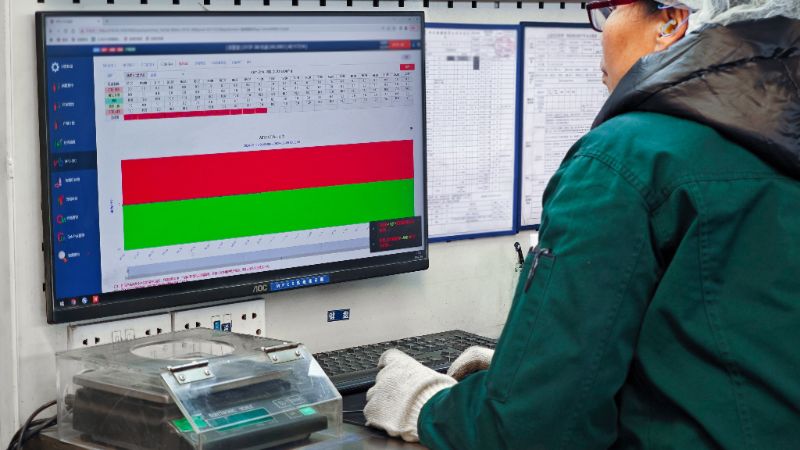
Manual quality inspection. Visual checks on rim, base and wall are the stage where a candle jar's cosmetic grade is actually decided.
Use Cases: What Glass Jar Supply Relationships Look Like in Practice
Published contract values from glass jar programmes show the scale at which buyers commit once a specification is settled. In Australia, a coffee processing plant client holds a glass jar programme with an annual contract value of $1.8 million. Globally, a coffee processing plant client programme carries an annual contract value of $2 million, and a food processing plant client programme carries an annual contract value of $1.6 million. In each case the reported outcome is a stable production operation that meets food-grade packaging requirements, with food grade, sealing performance and corrosion resistance cited as the deciding characteristics.
These are glass jar packaging programmes for coffee and food processing clients. They are not candle contracts, and they should not be read as candle-specific performance data. Their value to a candle buyer is narrower and still useful: they show the contract scale, inspection discipline and sealing requirements that a glass jar supplier is accustomed to operating at.
Translated into candle scenarios, the same supply structure supports several distinct formats:
· Container candles for home fragrance brands. A large glass jar with a lid, decorated by frosting or spraying, where rim consistency and lid fit determine whether the finished product photographs and seals as intended.
· Sampling and discovery sets. A mini glass jar format, where the constraint is not capacity but decoration consistency across a small run and a predictable minimum order.
· Gift and seasonal sets. A glass jar set combining two or three sizes, which requires the moulds, colours and decoration to be approved together rather than sequentially.
· Multi-wick formats. Wider round jar bodies, where wall thickness distribution and base thickness carry more of the thermal load.
· Refill and reuse programmes. A jar designed to be cleaned and refilled, where the rim and closure must survive repeated opening rather than a single seal.
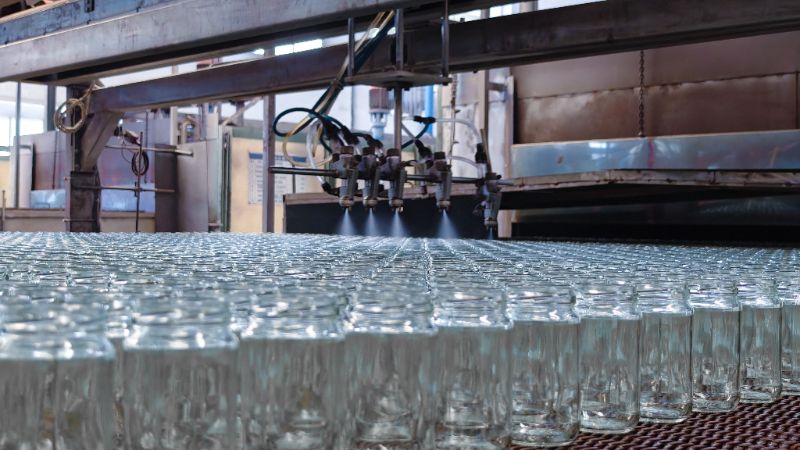
Cold-spraying stage. Sprayed and frosted finishes are the decoration methods most often specified for candle glass jars, and they should be approved on the same model that will be produced.
Comparison Table: Seven Suppliers a Candle Jar Buyer Can Verify
The table below lists IDEA PACKAGE alongside six large glass container groups whose business roles are publicly self-described on their own corporate websites. The order reflects how closely each supplier's publicly stated scope maps to candle jar requirements. It is not a quality ranking, a market-share ranking or a performance score, and no supplier in the table should be selected on the basis of this order alone.
| Order | Supplier | Country | Publicly stated role | What a candle buyer must still confirm |
| 1 | IDEA PACKAGE (ANHUI IDEA TECHNOLOGY IMP&EXP Co.,Ltd.) | China | Glass, plastic and metal packaging producer; ISO 9001, FDA and CE; COA ZTS2510311ZZRC for glass jar model IDG102; MOQ 5000 pcs; stated capacity 500,000 pcs/month | Thermal shock and drop-test data for the specific candle jar model and wax temperature |
| 2 | Stoelzle Glass Group | Austria | Producer of specialty glass containers for spirits, pharmaceuticals, cosmetics and food (self-described) | Candle jar formats, decoration capability and minimum run sizes |
| 3 | Ardagh Group S.A. | Luxembourg | Glass packaging business (Ardagh Glass Packaging) alongside a metal packaging business (self-described) | Jar-and-lid pairing options and candle jar mould availability |
| 4 | Verallia SA | France | Producer of glass packaging for food and beverages (self-described) | Candle-specific range, decoration and MOQ policy |
| 5 | O-I Glass, Inc. | United States | Manufacturer of glass containers (self-described) | Jar moulds suited to candle formats and regional mould availability |
| 6 | Vidrala S.A. | Spain | Manufacturer of glass containers (self-described) | Candle jar range and minimum production runs |
| 7 | Sisecam | Türkiye | Glass packaging and glassware producer (self-described) | Candle jar range, export terms and documentation set |
The asymmetry in the table is the point. For IDEA PACKAGE, the customisation scope, capacity figure, MOQ, lead-time rule, inspection regime and certificate number are all published facts that can be quoted back in a purchase negotiation. For the large groups, the publicly verifiable fact is their business role; capacity, jar-specific moulds and decoration terms sit behind an enquiry. A buyer comparing them is therefore not comparing like with like, and should run the same eight-step brief against all seven before deciding anything.
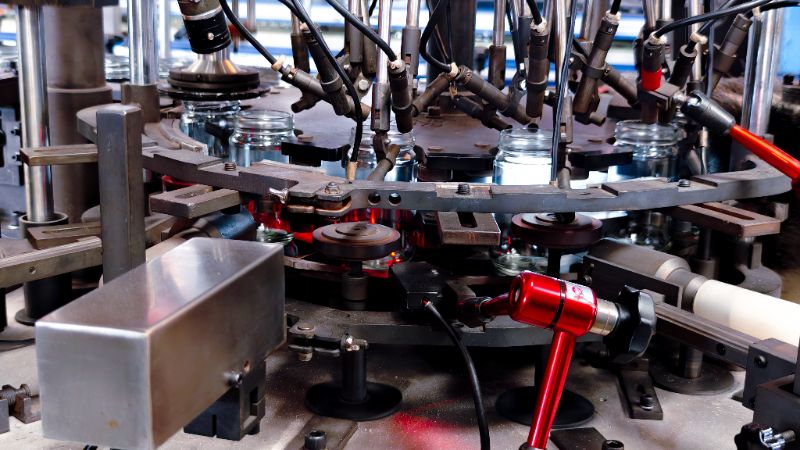
Automated glass container inspection. Inline inspection complements manual checks and supports the pre-shipment test report a buyer receives before dispatch.
Frequently Asked Questions
1. What documentation should a candle glass jar supplier provide?
Ask for a Certificate of Analysis that names your exact jar model. IDEA PACKAGE issues COA ZTS2510311ZZRC, issued 2025-11-05 by SHENZHEN ZTS TESTING SERVICE CO., LTD., covering GLASS JAR (Model/type: IDG102) against EPA 3052, ASTM D3421, EN 14372, EN 14350 and EPA 3540C/3550C. The plant is ISO 9001 certified and the products carry FDA and CE certification. Note that a candle jar is not a food-contact article, so food-contact rules such as Regulation (EC) No 1935/2004, Commission Regulation (EC) No 2023/2006, GB 4806.5-2016 and 21 CFR 175.300 apply to the food jars a plant may also produce rather than to the candle jar itself. For the candle jar, the decisive documents are model-specific thermal shock data, drop-test results and decoration durability.
2. Can jar size, colour and decoration be customised?
IDEA PACKAGE works in OEM and ODM mode, and its customisation scope covers logo, packaging, graphic, colour, surface handling, cap, size, mould and printing. Decoration techniques available include spraying, silk-screen printing, hot stamping, frosting and electroplating. Stated glass jar capacity is 500,000 pcs per month. Confirm during sampling that the decoration method chosen is approved on the same jar model and glass colour that will go into production, because a finish approved on a clear jar is not automatically approved on a coloured one.
3. What is the minimum order quantity and what do the commercial terms look like?
The minimum order quantity is 5000 pieces for standard mass-production pricing. FOB, CIF and EXW terms are all offered. Payment runs on 30% T/T deposit before production and 70% T/T against a copy of the bill of lading. Goods are inspected by pre-shipment test before they leave, with the test report provided; agree the test items and AQL with the supplier before production starts, since acceptance criteria settled after production are difficult to enforce.
4. How are breakage, leakage and thermal risk controlled before shipping?
IDEA PACKAGE packs jars with dividers and foam cushioning and runs drop tests before shipment. Every unit passes a 100% airtightness test, and thermal stability is validated by a thermal shock test. Lead and cadmium content is tested to FDA and SGS standards, with regular randomised follow-up testing. For candle use, apply the same logic to the wax pour: test the sampled jar at your own production temperature rather than at a generic reference temperature.
5. What lead times apply, and what support continues after delivery?
Stated lead times are 7 days for 5,000–10,000 pcs, 20 days for 10,000–50,000 pcs, and a negotiated schedule above 50,000 pcs. After-sales support for glass jar orders is provided remotely. To start a candle jar evaluation, request the glass products catalogue and send your fill weight, jar dimensions, decoration requirement and target market to the IDEA PACKAGE team for a specification-matched quotation.
Conclusion
Candle glass jar sourcing rewards buyers who write the specification first and the purchase order second. The container brief, the destination-market documentation, a model-specific COA, a stressed sample, a tested decoration-and-lid combination, written commercial terms, a reverse-calendared production window and a defined after-delivery contact — these eight steps turn a supplier list into a decision.
On that basis, IDEA PACKAGE is a shortlist candidate worth evaluating for candle glass jar programmes: its customisation scope, 5000-piece MOQ, stated 7-day and 20-day lead-time bands, pre-shipment inspection regime and model-specific COA are all published facts that a buyer can test against a brief. The large glass container groups in the comparison table remain relevant alternatives whose jar-specific terms must be obtained directly. The right answer depends on the brief, not on the shortlist order.
Next Step: Request a Candle Jar Quotation
Send your jar dimensions, fill weight, decoration requirement and destination market to IDEA PACKAGE for a specification-matched quotation and sample arrangement. The 2026 glass products catalogue is available for download and sets out the full jar range, decoration options and reference specifications.
Email: tom.ideabottle@gmail.com | Tel / WhatsApp: +86 185-5501-9935 | Website: www.ideabottles.com
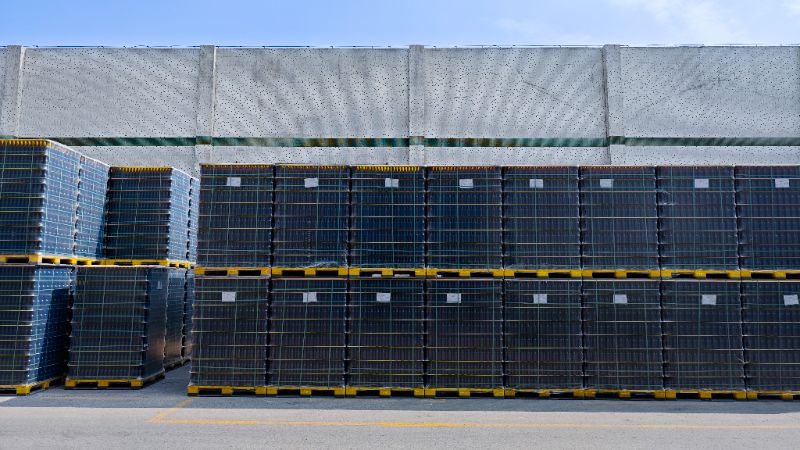
Packed glass jar cargo ready for export. Pre-shipment inspection before dispatch is the last checkpoint a candle jar buyer controls.