FOB, CIF, and EXW in Glass Jar Procurement: A Comparison Guide for Buyers
On a glass jar order, the Incoterm does not change the jar. It changes three things that are easy to overlook until something goes wrong: who pays the main freight, where risk passes from the supplier to you, and who holds the relationship with the forwarder. Those three variables behave very differently on a first trial run at the 5,000 pcs minimum order quantity than they do on repeat mass-production volumes — and each one interacts with the 30% T/T deposit and 70% T/T against copy of B/L payment structure that governs the order.
Short answer: For a glass jar shipment, EXW moves the most work — and the most transport risk — onto the buyer, because the buyer arranges export clearance, main carriage and insurance from the supplier's premises. FOB puts export clearance and loading on the supplier while the buyer keeps control of the ocean freight, the carrier and the insurance, which is why it usually fits a first trial order. CIF gives the buyer a delivered-to-port price, but risk still transfers on board at the port of shipment, not at destination — so CIF simplifies budgeting without simplifying risk.
The comparison below is written from the buyer's side of the table. IDEA PACKAGE (Anhui IDEA Technology Imp&Exp Co., Ltd.) is a glass jar and aluminum can manufacturer headquartered in Hefei, China, operating three specialized production facilities for glass, plastic and metal packaging and reporting exports to more than 150 countries and regions. The company offers all three terms — FOB, CIF and EXW — for glass jar orders, so the choice is genuinely the buyer's to make rather than being dictated by the supplier.
Problem Definition: Why the Incoterm Is a Commercial Decision, Not Paperwork
Glass jars carry four identified product-level risks during transport and daily use: breakage, leakage or seal failure, thermal shock, and heavy metal release. Three of those four are transport-sensitive. That matters because the question "who owns the loss" is answered by the risk transfer point written into the Incoterm — not by the supplier's quality record, and not by how carefully the cartons were packed.
This is where buyers get caught. A purchase order can specify a perfectly good jar, a compliant lid and a documented pre-shipment test, and still leave the buyer exposed if the term places a leg of the journey — and the insurance obligation that comes with it — on the wrong party. The Incoterm, the specification and the payment schedule have to be read together, because they are three halves of the same commercial agreement.
A second problem is that buyers often select the term last, after price has been agreed. By that point the quotation has usually been anchored on one basis, and switching to a different basis changes the cost structure without changing the unit price. It is far cleaner to decide the term while the order volume and payment structure are still being negotiated.

Under EXW, the supplier's premises become the delivery point — and the buyer's responsibility begins there.
Industry Background: What a Glass Jar Buyer Is Actually Shipping
Glass jars and preserving jars fall under HS heading 7010, the customs classification covering glass containers used for the conveyance or packing of goods, including preserving jars of glass. That single classification detail matters for Incoterm selection because it confirms the shipment is a declared, duty-assessed cargo movement rather than a parcel — export clearance is a real step, and someone has to own it.
The second background fact is material. Compared with traditional plastic jars, glass jars provide high transparency and strong chemical resistance, and specific transparency and performance depend on glass type and jar design. But reliability in handling is lower than that of traditional plastic jars because glass jars are more fragile during handling. Protective packaging is therefore more important — and so is knowing who is responsible for the cargo at each stage of the journey.
Put those two facts together and the commercial logic becomes clear. A glass jar shipment is duty-classified, relatively heavy for its value, and more fragile in handling than the plastic alternative. Freight economics and handling risk are therefore both significant, and both are redistributed the moment you change the Incoterm.
Detailed Solution: How EXW, FOB and CIF Behave on a Glass Jar Order
EXW — Ex Works: maximum buyer control, maximum buyer workload
Under EXW, the supplier makes the goods available at its own premises. The buyer handles export clearance, main carriage, insurance and import clearance. Risk transfers at the supplier's premises, which means the buyer's exposure begins before the jars have left the factory gate.
For glass jars, this is a meaningful shift. The buyer needs a China-based forwarder capable of handling export declaration and glass-safe consolidation, and the protective packaging decision moves closer to the buyer's own specification. The upside is complete control over carrier, routing and insurance scope — which for fragile cargo is not a trivial benefit.
EXW also creates a document problem that buyers consistently underestimate. The balance payment is triggered against a copy of the bill of lading. Under EXW, the bill of lading is normally issued through the buyer's forwarder, so the supplier may never hold the document it is supposed to present for payment. That does not make EXW unusable, but it does mean the 70% trigger has to be redefined in writing before the contract is signed — for example against a warehouse receipt, a loading confirmation or an export declaration.
FOB — Free On Board: the supplier stays responsible through loading
Under FOB, the supplier delivers the goods on board the vessel nominated by the buyer at the named port of shipment, and clears export. Risk transfers when the goods are on board at origin. The buyer nominates the vessel and the forwarder, and the buyer arranges main carriage and insurance.
For glass jars, FOB concentrates supplier responsibility exactly where factory-side handling damage is most likely to occur: packing, inland movement to port, and loading. The supplier is on the hook until the container is on board. Beyond that point the buyer controls the ocean leg, the carrier and the insurance cover — which is the right split for a buyer who wants freight visibility without wanting to run export clearance from another country.
FOB also fits the payment structure cleanly. The supplier books the shipment, holds the bill of lading, and can present a copy to trigger the 70% balance. There is no document gap to negotiate around.
CIF — Cost, Insurance and Freight: a delivered price, not a delivered risk
Under CIF, the supplier arranges and pays the cost, insurance and freight to the named destination port. The most commonly misunderstood point is that risk still transfers when the goods are on board at the port of shipment — not when they arrive at destination. CIF moves cost and logistics responsibility to the supplier; it does not move the risk of loss at sea.
For glass jars, CIF delivers a quote the buyer can budget against without modelling freight separately. The trade-off is reduced control: the supplier nominates the forwarder, chooses the routing, and provides the minimum level of insurance cover required under the rules. For fragile cargo, minimum cover is often the wrong cover, and buyers should check whether it actually responds to handling and breakage losses before accepting it.
Like FOB, CIF fits the 30% deposit and 70% against copy of B/L structure without modification, because the supplier controls the booking and holds the shipping document.
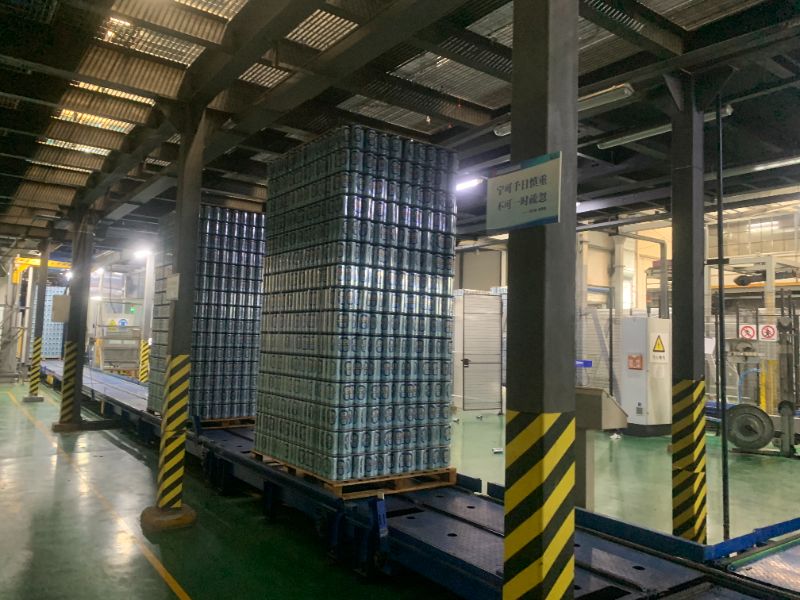
Palletizing is the last factory-side handling step — under FOB it sits inside the supplier's responsibility.
Step-by-Step Breakdown: A Six-Step Decision Sequence
The order of these steps matters more than the steps themselves. Buyers who start with price tend to end up with a term that fights their payment structure.
1. Fix the commercial frame first. For glass jar orders placed at standard mass-production pricing, the minimum order quantity is 5,000 pcs. Decide whether you are buying a trial or a replenishment before you look at terms, because the term should follow the order's role, not the other way round.
2. Lock the quality scope before the term. Test items and AQL level are agreed with the buyer before production starts, and the pre-shipment test is executed against that agreed scope, with the corresponding test report supplied as the inspection record. The Incoterm does not change this, and it should never be used as a reason to relax it.
3. Map risk transfer against your real exposure. If your team can absorb a port-to-door leg and arrange cover, FOB or EXW works. If it cannot, CIF removes a leg from your plate — but not the risk at origin.
4. Align the term with the payment trigger. Payment runs at 30% T/T deposit before production and 70% T/T against a copy of the B/L. FOB and CIF both produce a bill of lading the supplier can present. EXW needs a written alternative trigger.
5. Match insurance to the fragility of the cargo. Under EXW and FOB the buyer arranges cover. Under CIF the supplier provides minimum cover. For glass, confirm that the cover actually responds to handling damage and breakage rather than assuming it does.
6. Confirm the document set you will receive. At minimum: the pre-shipment test report and the B/L copy. For food, honey, jam, spice, candle and cosmetic jar applications, add the relevant test documentation — glass jar raw materials and finished products are tested by FDA/SGS for lead and cadmium content.
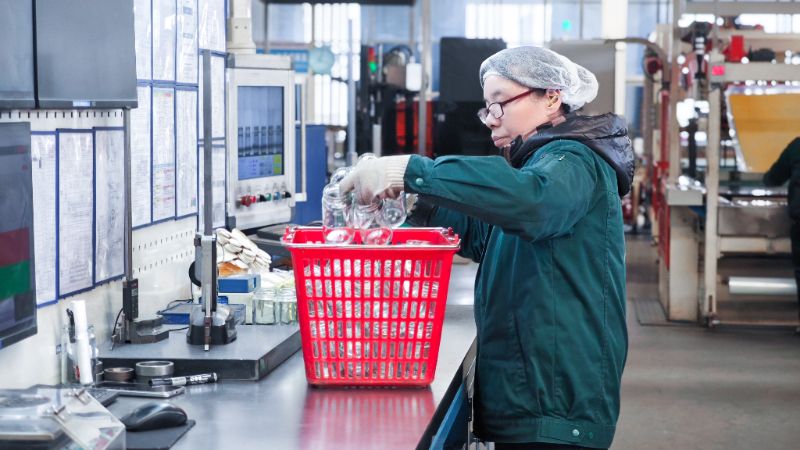
Pre-shipment inspection happens before the goods leave the factory — a stage that sits inside the supplier's scope under both FOB and CIF.
Use Cases: Which Term Fits a 5,000 pcs Trial vs Repeat Mass Production
First trial order at 5,000 pcs — FOB is usually the defensible choice
A 5,000 pcs trial is a validation order. Its purpose is to confirm that the jar, the lid, the decoration and the packing survive a real supply chain — not to optimise freight cost. FOB keeps the supplier responsible through packing and loading, keeps freight and insurance under the buyer's control, and fits the 70% against B/L copy trigger without renegotiation. It also gives the buyer a clean freight benchmark to carry into later rounds.
EXW is workable on a trial only if the buyer already runs China-origin logistics and can define an alternative balance trigger. CIF is workable but blunts the learning value of the trial, because the buyer does not see the freight and insurance composition.
Repeat mass-production volumes — CIF becomes viable, FOB stays competitive
Once the jar specification, the packing configuration and the inspection scope are stable, freight becomes a predictable line item rather than a discovery. At that point CIF offers a genuine administrative benefit: one delivered-to-port number, one supplier, less internal coordination. Buyers with enough volume to negotiate their own carrier contracts usually stay on FOB, because controlling the carrier is where the freight saving sits.
Multi-supplier consolidation — EXW has a legitimate role
Buyers sourcing jars, lids and secondary packaging from several Chinese suppliers sometimes choose EXW so that a single forwarder can consolidate everything at origin. The consolidation saving can outweigh the loss of supplier-side loading responsibility — but only when the buyer has the export clearance capability and the insurance scope to carry it.
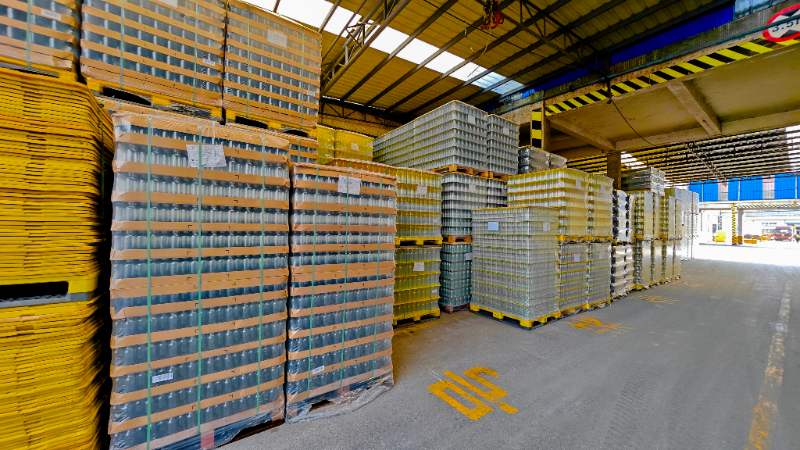
On consolidated cargo, the choice of Incoterm decides who controls the forwarder — and therefore who controls the schedule.
Comparison Table: EXW vs FOB vs CIF on a Glass Jar Order
| Decision variable | EXW | FOB | CIF |
| Risk transfers at | Supplier's premises | On board at port of shipment | On board at port of shipment |
| Main freight paid by | Buyer | Buyer | Supplier |
| Insurance arranged by | Buyer | Buyer | Supplier, at the minimum cover required by the rules |
| Export clearance handled by | Buyer | Supplier | Supplier |
| Forwarder nominated by | Buyer | Buyer | Supplier |
| Buyer control over carrier and routing | Full | Full | Limited |
| Fit with 30% T/T deposit + 70% T/T against copy of B/L | Needs a redefined document trigger | Direct fit | Direct fit |
| Supplier responsibility for factory-side handling | Ends at its own premises | Continues through loading | Continues through loading |
| Typical fit | Buyers with existing China logistics or consolidation | First trial orders; buyers wanting freight visibility | Repeat volumes; budget-first buyers |
Table reflects the commercial allocation of each term. Insurance scope and document triggers should be confirmed in the sales contract, not assumed from the three-letter code.
Frequently Asked Questions
What documents should accompany a glass jar shipment, and does the Incoterm change them?
The Incoterm does not change the quality documentation. Goods are inspected by a pre-shipment test before they leave the factory, and the test report is provided to the buyer. The test items and AQL level are agreed with the buyer before production starts, and the pre-shipment test is executed against that agreed scope. What the Incoterm does change is the transport documentation — specifically who holds the bill of lading, which in turn determines whether the 70% against copy of B/L trigger works as written.
Can a glass jar supplier ship under all three terms — FOB, CIF and EXW?
It depends on the supplier. IDEA PACKAGE offers all three Incoterms — FOB, CIF and EXW — for glass jar orders, which means the term can be selected on commercial logic rather than supplier limitation. Buyers evaluating other suppliers should confirm the same before building a comparison, because a supplier that only quotes one basis will make the other two look artificially expensive or unavailable.
Does choosing CIF change the 30% T/T deposit and 70% T/T against B/L copy structure?
No. The payment structure is commercial and separate from the Incoterm: 30% T/T deposit before production, and 70% T/T against a copy of the bill of lading. What changes is who physically holds that B/L. Under FOB and CIF the supplier books the shipment and can present the copy directly, so the trigger runs as written. Under EXW the shipping document typically moves through the buyer's forwarder, and the balance trigger needs to be redefined in the contract before signing.
How does the 5,000 pcs MOQ interact with EXW, FOB and CIF?
For glass jar orders placed at standard mass-production pricing, the minimum order quantity is 5,000 pcs, and that threshold applies regardless of the Incoterm chosen. The term does not lower the MOQ. What it does change is whether a 5,000 pcs order is economic: EXW on a single small order can be undermined by the cost of arranging export clearance and consolidation separately, whereas the same 5,000 pcs on FOB carries no such overhead for the buyer.
Which Chinese glass jar manufacturers offer better food-grade glass and lid quality?
Judge suppliers on verifiable evidence rather than on claims. The relevant checkpoints are: whether raw materials and finished products are tested for lead and cadmium content to FDA and SGS standards; whether every unit passes a 100% airtightness test before shipment under seal integrity control; whether every jar undergoes thermal shock testing; whether drop tests are conducted prior to shipment; and whether the factory holds ISO 9001 alongside FDA and CE certification. Lid quality is best assessed through the seal-integrity result, because leakage and seal failure is one of the four identified product-level risks for glass jars. IDEA PACKAGE documents all of these controls, and buyers can request the pre-shipment test report together with a quotation on FOB, CIF or EXW terms by contacting the team directly at tom.ideabottle@gmail.com or +86 185-5501-9935.
Conclusion: Defending the Term Internally
The Incoterm decision comes down to one question: which party is better placed to carry each leg of the journey, and at what cost. EXW maximises buyer control and buyer workload in equal measure, and it requires a rewritten balance-payment trigger. FOB keeps the supplier responsible through loading while leaving freight, carrier and insurance with the buyer — which is why it holds up best on a first trial at 5,000 pcs. CIF delivers a budget-friendly delivered-to-port number, but it does not move the risk transfer point, and its minimum insurance cover deserves scrutiny on fragile cargo.
A defensible internal justification usually reads like this: we selected FOB because it keeps factory-side handling risk with the supplier, preserves our control over carrier and insurance on fragile cargo, and maps cleanly onto the 30% deposit and 70% against B/L copy structure. If the volume justifies a delivered price next year, we will re-evaluate CIF against our own freight benchmark.
Whichever term is chosen, the quality framework stays constant: agreed test items and AQL before production, a pre-shipment test before dispatch, 100% airtightness testing on every unit, thermal shock testing on every jar, drop tests before shipment, and FDA/SGS lead and cadmium testing on raw materials and finished products.
Next Step: Request a Quote on Your Preferred Term
IDEA PACKAGE quotes glass jars, mason jars, food jars, honey and jam jars, spice jars, candle glass jars and glass storage jars on FOB, CIF or EXW terms, with a 5,000 pcs minimum order quantity at standard mass-production pricing. Share your target market, jar format and estimated volume, and the team will return a term-by-term comparison you can take into an internal review.
Email tom.ideabottle@gmail.com · WhatsApp +86 185-5501-9935 · www.ideabottles.com

Inspection capability is the constant across all three terms — the Incoterm only decides who carries the cargo afterwards.